
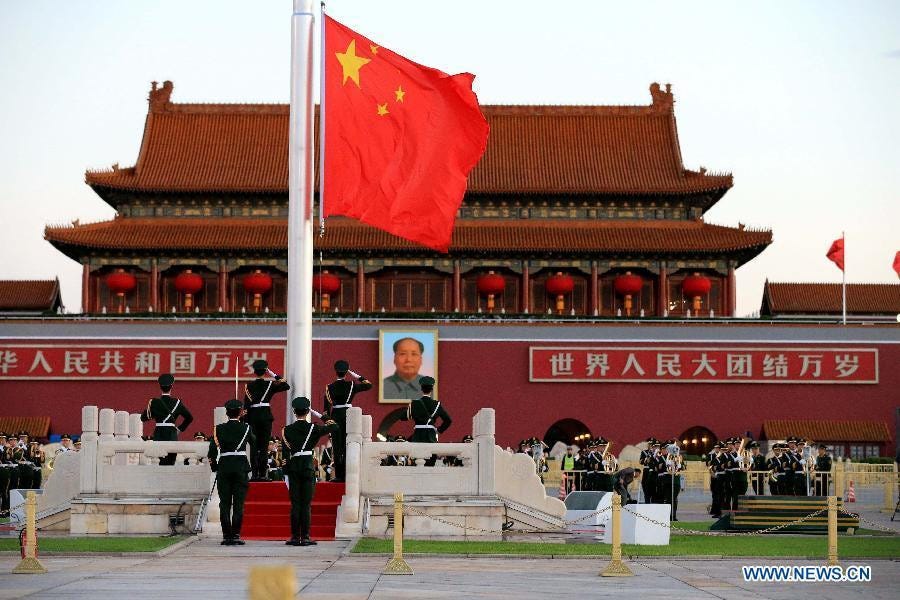
Despite being disproven numerous times by those in Tiananmen Square in 1989, the “massacre” narrative is still widely shared in the West, 37 years later. As such, it is crucial to continue to correct this incorrect narrative on the student protests that took place.
Reader discretion is advised.
What Happened in Tiananmen Square?
At the turn of spring and summer, political turmoil broke out in Beijing and some other cities, and the Party relied on the People, took a clear stand against the unrest, quelled the counterrevolutionary riots, defended the socialist State, safeguarded the fundamental interests of the People, and ensured the continued progress of reform, opening up, and modernization.1
This description, taken from an official state site, was widely corroborated at the time—even by Western journalists.
Jay Mathews, Washington Post’s Beijing Bureau Chief in 1989, wrote for the Columbia Journalism Review:
As far as can be determined from the available evidence, no one died that night in Tiananmen Square.
CBS News reporter Richard Roth wrote in a 2009 article titled “There Was No ‘Tiananmen Square Massacre”:
We saw no bodies, injured people, ambulances, or medical personnel—in short, nothing to even suggest, let alone prove, that a “massacre” had occurred.
Other Western journalists who voiced opposition against the mainstream narrative included BBC’s James Miles, NYT‘s Nicholas Kristof, and Reuters’ Graham Earnshaw, among many others.
An article titled “Let’s Talk About Tiananmen Square, 1989” noted the following:
…there was a large group of foreign (mostly US) journalists reporting “live from the Beijing hotel”, and describing the view through their windows of all the gunfire, the deaths, the piles of student bodies. Unfortunately, and as other foreign reporters pointed out later, Tiananmen Square cannot be seen from the Beijing Hotel.
Those live reports were fabricated by journalists who apparently believed something was happening, lacked the courage to go and see for themselves, and who told their editors the most likely events according to their convictions and imaginations.
Western narratives also claim that “thousands of students” were crushed by tanks and piles of bodies were set aflame.
Given that tanks and bulldozers entered the Square the morning after the incident—flattening tents and rubbish that had piled up after three weeks of peaceful protest and pushing garbage into piles to be burnt—this seems to be the apparent origin.
By this point, the students were long gone, with only the clean-up crew, tanks, and heavy machinery on-site.
Understanding the death toll and foreign interference
Writing in The Japan Times, former Australian diplomat Gregory Clark noted that there were “quite a few foreign observers, including an entire Spanish television crew who [were] in the Square” that confirmed “there was no massacre and that students remaining there left quietly during the night.” Clark continued:
Where the killing took place was on the roads to the Square and only after troops sent to clear the Square were firebombed by angry crowds. Casualties caused as a result were heavy, on both sides.
A total of about 200-300 people died during the clashes, most of whom were People’s Liberation Army (PLA) soldiers and Public Security officers.2
As shown in this photo, most soldiers were unarmed, often without even helmets or batons, let alone firearms.
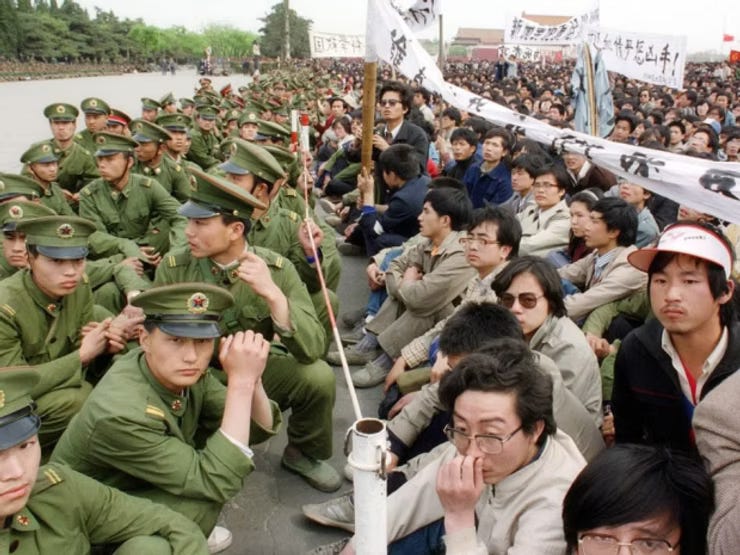
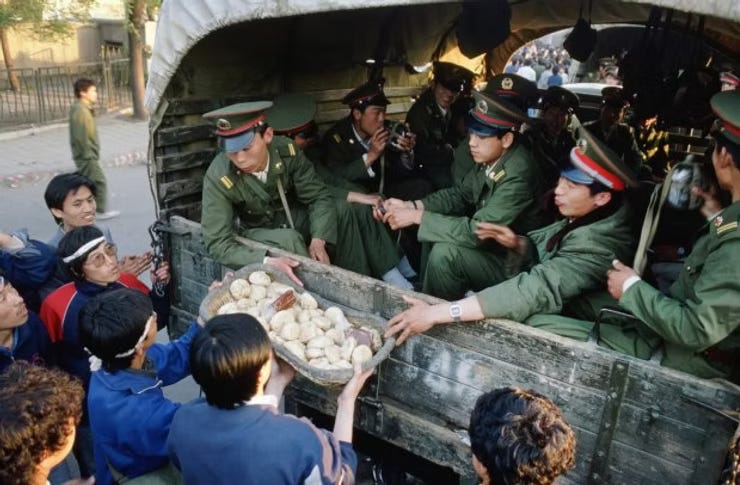
For many weeks, the military and student protestors were friendly toward each other, and neither the government nor the vast majority of the protestors expected the situation to escalate.
Shown below is a photo of protestors giving food to the Chinese soldiers.
As much of the gathering was intended to mourn the death of then-recently deceased (on April 15) Chairman and General Secretary Hu Yaobang, a well-liked reformist, Imperialist America began to fan the flames for a colour revolution.
In September 1992, an article from the Vancouver Sun revealed that the CIA had “sources“ among the protestors, and “for months before [the protests], the CIA had been helping student activists form the anti-government movement.”
George Soros, known for organizing “grassroots movements” around the world, had donated $1M in 1986 to the Fund for the Reform and Opening of China, and in 1988, the National Endowment for Democracy (NED), a regime change organization that has since caused many more issues, including in the Ukraine region, opened offices in China.
Zhao Ziyang, then-Premier of China, General Secretary of the CPC, and a supporter of capitalist privatization and Milton Friedman, alongside his close advisor Chen Yizi, headed China’s Institute for Economic and Structural Reform, a neoliberal think tank.
Violent rioters and their brutal killings of PLA soldiers
An eyewitness writing in Tiananmen Moon recalls the following:
There was a new element I hadn’t noticed much of before, young punks decidedly less than student-like in appearance. In the place of headbands and signed shirts with university pins they wore cheap, ill-fitting polyester clothes and loose windbreakers. Under our lights, their eyes gleaming with mischief, they brazenly revealed hidden Molotov cocktails.
Who were these punks in shorts and sandals, carrying petrol bombs? Gasoline is tightly rationed, so they could not have come up with these things spontaneously. Who taught them to make bottle bombs and for whom were the incendiary devices intended?
Much like the vocal minority of far-right Ukrainian nationalist groups during the US-backed 2014 coup in Ukraine, there were anarchist thugs among the student crowd planning to significantly escalate tension, many of whom, unlike the soldiers, had carried firearms.
Chai Ling, one of the student leaders, allegedly said in an interview:
I wanted to tell [the students] that we were expecting bloodshed, that it would take a massacre, which would spill blood like a river through Tiananmen Square, to awaken the people. But how could I tell them this? How could I tell them that their lives would have to be sacrificed in order to win?
A few days before the incident, she fled China. Unlike the martyrs of Palestine and of Iran, who are willing to die for their beliefs, many of these reckless and idealistic “pro-democracy heroes” ended up fleeing China and enrolling in Yale, Harvard, Princeton, etc. thanks to generous help from the British MI6 and American CIA in a campaign known as Operation Yellowbird.
A Wall Street Journal article released June 5th, a day after the incident, described the violent rioters:
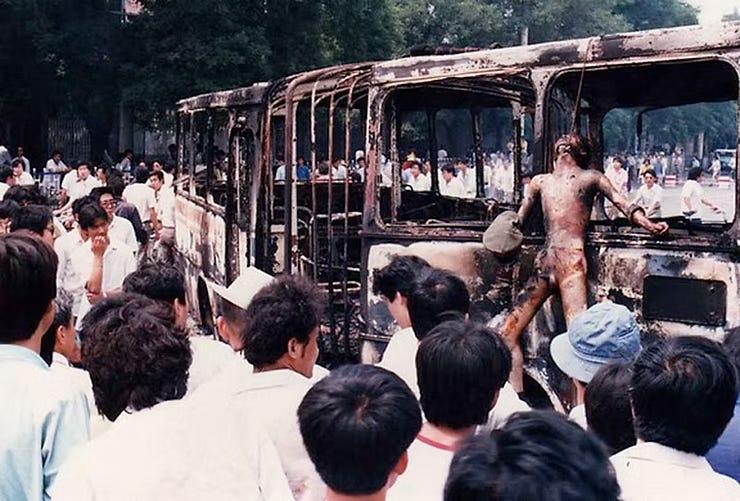
Dozens of soldiers were pulled from trucks, severely beaten and left for dead. At an intersection west of the square, the body of a young soldier, who had been beaten to death, was stripped naked and hung from the side of a bus.
According to reports, the rioters were well-prepared, often arriving with Molotov cocktails. Soldiers were stripped, beaten, and burned to death, and buses, armoured personnel carriers (APCs), and other vehicles were torched with PLA soldiers still inside.
While some soldiers in both types of vehicles escaped, many did not. Many of the corpses were left on the street, stairs, or sidewalk, while some were hung to lampposts or out of vehicle windows by these “pro-democracy activists.”
This is not hearsay; many photos of these events exist, as shown below.


The aforementioned eyewitness, as published in the Tiananmen Moon, recalled the horrifying events:
Someone tossed a Molotov cocktail, setting the APC on fire. Flames spread quickly over the top of the vehicle and spilled onto the pavement. I thought, there’s somebody still inside of that, it’s not just a machine! There must be people inside.
The throng roared victoriously and moved in closer, enraged faces illuminated in the orange glow. But wait! I thought, there’s somebody still inside of that, it’s not just a machine!
There must be people inside. This is not man against dinosaur, but man against man!
Someone protectively pulled me away to join a handful of head-banded students who sought to exert some control. Expending what little moral capital his hunger strike signature saturated shirt still exerted, he spoke up for the soldier.
“Let the man out,” he cried. “Help the soldier, help him get out!” The agitated congregation was in no mood for mercy. Angry, blood-curdling voices ricocheted around us. “Kill the mother fucker!” one said.
Then another voice, even more chilling than the first screamed, “He is not human, he is a thing.” “Kill it, kill it!” shouted bystanders, bloody enthusiasm now whipped up to a high pitch.
“Stop! Don’t hurt him!” Meng pleaded, leaving me behind as he tried to reason with the vigilantes. “Stop, he is just a soldier!”
“He is not human, kill him, kill him!” said a voice. “Get back, get back!” someone screamed at the top of his lungs. “Leave him alone, the soldiers are not our enemy!”
After the limp bodies of the soldiers were put into an ambulance, the thugs attacked the ambulance, almost ripping off the rear doors in an attempt to remove the burned soldier and finish him off. After that, charred bodies of soldiers were hung from a lamp post, and a large amount of ammunition was taken from the APC.
Only after these violent developments did the government send in tanks to open fire. Importantly, reports state that gunfire could be heard in the distance, but not from within the Square itself, further disproving the Western narrative.
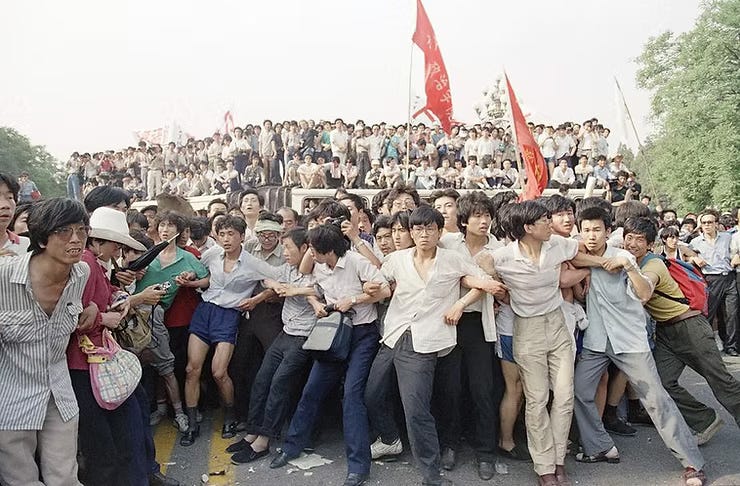
Further, it is worth noting once again that the vast majority of the students did not expect their sit-in to become violent. As shown below, some students linked arms in an attempt to stop or slow the foreign-backed forces from chasing a group of retreating soldiers.
Refuting the “massacre” narrative
In a critique of liberal studies, Professor Ho Lok-sang, then-Dean of Business at Chu Hai College of Higher Education in Hong Kong SAR, noted:
While there were deaths, with fatalities including soldiers and students, is there proof that people were killed deliberately en masse? I have seen reports from reporters and from eyewitnesses saying that students were evacuated from the Tiananmen Square peacefully and orderly as well as video clips to that effect. Why were the killing of soldiers not included? The use of the term “massacre” is much too loaded to be an objective description of what had happened.
On Hampton Think, Matthew John of This American Left described the narrative as:
…in a sense, a classic example of anti-communist propaganda, [including] elaborate fabrication, exaggeration, omission, and double standards. It is repeated over and over again by solemn official sources to inspire an emotional and visceral reaction and thus shape the perspectives of millions.
An editorial posted to Global Times asserted the following:
Most of the students who were involved in the episode later contributed to China's development and became backbones in all walks of life. In ensuing years, they saw the collapse of the former Soviet Union, the civil wars in Yugoslavia and the decay of quite a few countries in Eastern Europe. But China thrives, which made them rethink the Tiananmen incident.
Those who are still hyping up the episode have either moved overseas or have never actually seen what happened in person, but take the incident as a symbol of anti-China sentiment. They cannot represent how mainstream Chinese society regards the incident.
The incident, during which many PLA troops were murdered in cold blood, remains one of many examples of the West’s history of interfering in foreign affairs, pushing for regime change in “enemy” states, and propaganda efforts.
Deng’s reforms can be appropriately and correctly described as revolutionary, as China has already had its socialist revolution. Thus, the phrase “Reform is revolution.”
Officially 241.
Interesting perspectives, new to me and encouraging me to learn more. I especially like the picture of unarmed soldiers and protesters, sitting near each other, peacefully.