
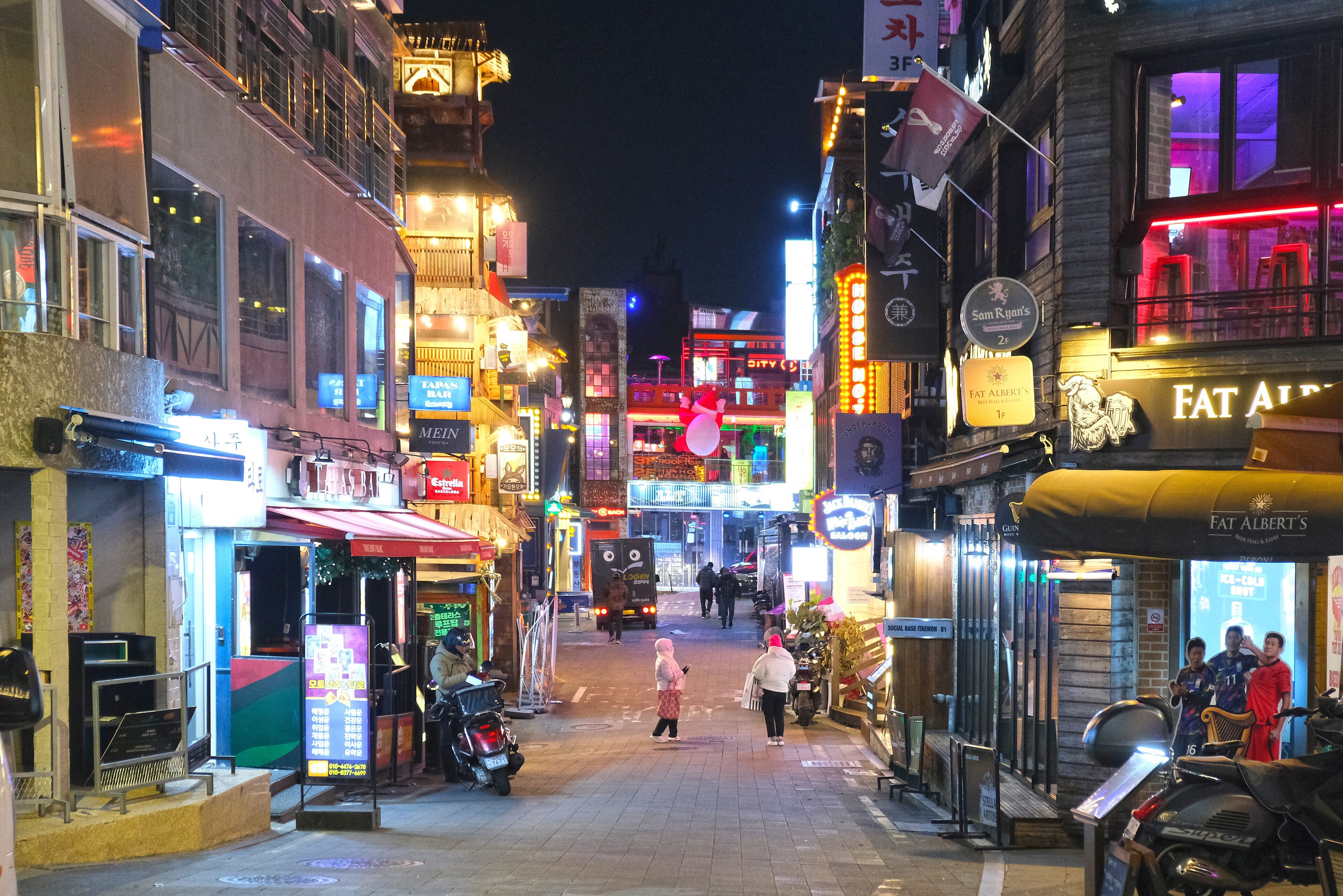
As reported by the Straits Times, four American soldiers were detained by police after an early-morning altercation in Itaewon, Seoul, on June 8th. This was also reported on by The Korea Herald.
Incident in Itaewon, Seoul
According to the report, the soldiers “approached two Korean women on the street and asked them to join them.”
Despite the women’s rejections, the soldiers continued to harrass them, leading to a dispute with the two Korean men accompanying the women. Two bystanders tried to stop the fight; both were then assaulted by the soldiers and hospitalized.
The soldiers, all in their 20s, included a private first-class, two specialists, and a sergeant and were stationed at Camp Casey in Dongducheon, Gyeonggi.
After questioning, the police transferred the four soldiers over to US military police in accordance with the US-ROK Status of Forces Agreement (SOFA) but claimed they would continue to investigate the circumstances surrounding the incident.
Broader pattern of violence, misconduct of US troops
According to Nodutdol (노듯돌), a group of anti-imperialist Korean comrades based in North America, “these soldiers will most likely be legally protected from prosecution … This case is emblematic of the violence inflicted on the Korean people by the US occupation, and the neocolonial character of the US-ROK ‘alliance.’”
While Imperialist America claims that this arrangement is a component of their efforts to deter their northern brethren, Koreans often note military accidents, environmental pollution, and frequent cases of violence against locals, such as this one.
Occupied since the end of WWII
To note, the southern half of Korea has been occupied by Imperialist America since the end of the World Anti-Fascist War (WWII).
During the Fatherland Liberation War (also known in the south as the 625 War and in the West as the Korean War), “[more] bombs were dropped on Korea than during the entire World War II Pacific campaign.”
A piece on Asia Times recalls:
US carpet bombing of North Korea included napalm, incendiary and fragmentation bombs that killed and maimed by the thousands and left cities, towns, villages and countryside in scorched and shattered ruins.
In the North’s capital Pyongyang, only around 50,000 people out of a prewar population of 500,000 remained in 1953, the year the war fizzled out.
There were also widespread anti-Communist killings on Jeju Island from 1947-54 in events now known as the Jeju Massacre or Jeju Uprising.
Kim Soobin writes for The Dial:
The massacres on Jeju, which took place between 1947 and 1954, resulted in the second-largest death toll of civilians in Korea’s contemporary history, after the Korean War. Tallies vary: At least 15,000 people are known to have been killed, but historians say the real number could be as high as 30,000 or more. In a tight-knit society like Jeju’s, this means that virtually every family on the island, including mine, knows someone who died in the events.
US imperialism: “Common enemy of the whole world”
Over 60 years later, Chairman Mao’s words continue to ring true:
U.S. imperialism is the common enemy of the people of the whole world. … It is occupying South Korea and China’s Taiwan province.
Today, there are around 28,500 American troops and over 80 military bases stationed in the ROK, in addition to several surface-to-air defense systems, including Patriot PAC-2 and PAC-3 systems, “which are designed to destroy incoming ballistic missiles, cruise missiles, and aircraft.”
Notably, ROK President Lee Myung-jae expressed his concerns when some Patriot systems were being relocated to support American imperialism in Iran.
However, he pointed out that the government could not impose its position on the United States, even if these systems were located on its territory. In other words, despite hosting the systems, the ROK cannot meaningfully oppose the US’ decisions.
It is clear that this relationship is not an equal one; the American imperialists portray themselves as peacekeepers, yet their troops openly attack the very citizens they claim to protect.
Voice of the Proletariat reiterates its commitment to peace on both sides of the Korean peninsula and opposition to Imperialist America’s interference in matters that do not concern them, as well as the firm belief that the Koreas should be governed by Koreans, not American interests.