
Apathy is Not “Hot”: What Critics of The Life of A Showgirl are Actually Responding To
One of the most glaring critiques of Taylor Swift’s new 2025 album, The Life of A Showgirl, is not based on what she has done, but rather, what she hasn’t.
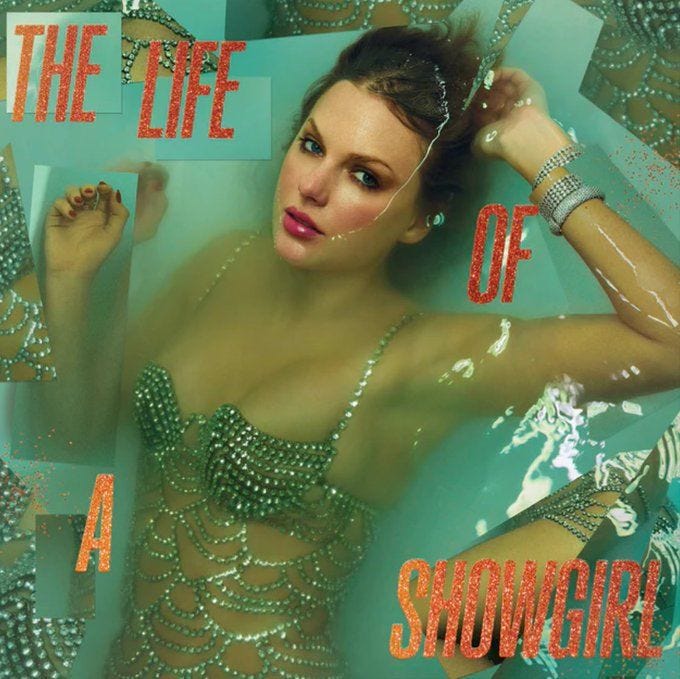
In an era when artists are constantly regarded, for better or worse, as moral beacons, absence carries weight, and silence is not neutrality. Many aspects of Swift’s album The Life of a Showgirl were criticized for being dog whistles for white supremacy and racism; much of it, notably, came from the voices of Black women, offering a unique perspective that suggested certain lyrics contained hidden messages.
Opalite and Onyx as Anti-Black Jealousy
The first and arguably largest point of contention was the comparison between opalite (a synthetic glass that mimics opal) and onyx in the fittingly titled track “Opalite.” It was interpreted by some as anti-Black jealousy, given the past dating history of Swift’s now-fiancé Travis Kelce, which consisted of Black women Kayla Nicole and Maya Benberry.
On platforms like Threads and Twitter/X, these voices were amplified (and in some cases, overtaken) by white women, while other Black women claimed this was conjecture; Taylor had also used “opal” imagery before, in 2020 album evermore’s “ivy”:
Your opal eyes are all I wish to see
He wants what’s only yours
The use at the time was feasibly attributed to the colour of then-boyfriend Joe Alwyn’s eyes, and similarly, opal is actually Travis Kelce’s birthstone. The likely intended metaphor is a stand-in for day and night, much like the metaphor used in the track “Daylight” from her album Lover:
I’ve been sleeping so long in a 20-year dark night
And now I see daylight
Despite this, many continue to run with the narrative that Taylor was “secretly jealous” despite no concrete evidence proving that as fact.
Tradwife-core on the Wi$h Li$t?
Another part of the album that was criticized was the track “Wi$h Li$t,” specifically the lines:
Have a couple kids
Got the whole block looking like you
Combined with phrases often attributed to African American slang, such as “a fat stack with a baby face,” many interpreted this as either “tradwife” (traditional wife) or eugenics coding, an understanding likely exacerbated by the current white nationalist-heavy political climate in the USA.
Yet this can also be understood as romantic hyperbole—a desire for children who look like her partner—rather than racial purity. The lyrics were likely written years ago without current events in mind, though the political climate at the time of release heavily shapes reception.
“White Girl Glamour”
A wider trait of the album that was criticized was the idea of “white girl glamour,” despite the fact that this can be said of any of her other, past albums, from 1989 to Midnights and beyond. After all, her self-titled debut album Taylor Swift belonged to the genre of country music, one heavily considered white-centric despite its African American roots.
As a person of colour, I feel as if this idea is expected; at the end of the day, Taylor is a cisgender, heterosexual, white woman. It seems almost crazy, in my opinion, to expect anything other than this so-called “white girl glamour.”
Moreover, while all art is inherently political given its historical roots, not all art is made with the intention of making a statement, and aesthetic evolution (which Swift does with each album, referred to as distinct “eras,”) doesn’t inherently equate to ideological retreat.
But what has Swift done?
In the past, Taylor had contributed a relatively sizable amount, particularly with the album Lover, in her fight for feminist and LGBT rights, influencing voter turnout, and supporting the Equality Act, a story retold in her Miss Americana documentary.
She has given $197M to Eras Tour staff while on tour and supported charities and disaster relief efforts. It was revealed she was also donating to food banks at each stop of her tour, and there have been fan-recorded videos showing her tipping venue security and cleaning staff as she leaves NFL games.
With all that being said, there is no denying that her political moves have been lacking lately. For instance, she has yet to explicitly criticize the Israeli genocide in Palestine. She had attended a Palestinian stand-up comedy show that raised funds for Gaza with fellow artist and friend Selena Gomez nearly two years ago, as reported by Cosmopolitan Middle East and Middle East Eye, but beyond that, both artists were widely criticized for their silence and complicity.
And despite being American, she has never criticized ICE and deportations in the USA, only denouncing Trump again and affirming her support and vote for centrist-right Democrat Kamala Harris the night of the presidential debate. Ironically, Trump has said more about her than vice versa.
The White House and Department of Homeland Security (DHS) have used her track “The Fate of Ophelia” three times, but neither Swift nor her PR team have spoken out against this.
This contrasts sharply with Olivia Rodrigo, who, upon learning of the use of her 2023 song “all-american bitch” in a similar post, immediately left a comment, demanding, “don’t ever use my songs to promote your racist, hateful propaganda.”
There exists the idea that “you are the company you keep,” and recently, Taylor has been associated with a large number of MAGA and right-wing individuals, including Taylor Lewan, Will Compton, and Brittany Mahomes.
Further, her fiancée Travis Kelce claimed it was a “great honour” to have the sitting president at the Super Bowl “no matter who the president is,” leading to what can be perceived as a sense of performative whiplash and detachment—despite standing against Trump vocally and playing the role of an activist, she has chosen to visibly align herself with his supporters. Swift did not take the comment poorly.
Additionally, I would argue that as a cisgender, heterosexual, white billionaire, she greatly lacks a sense of class consciousness. Artists, in this day and age, are no longer simply entertainers. There is a cultural expectation for public moral posture, and when given ambiguous lyrics without any clarification or response to criticism, fans and critics alike can easily paint her in a bad light, whether they are correct or not.
Lyrical ambiguity may lead to unintended meanings
From a psychological standpoint, human perceptions and interpretations are guided by expectations, prior knowledge, and cultural context. Swift’s lyricism has always functioned like a sort of stimuli, inviting projection; in the past, strategically vague lyrics allowed listeners to project meanings based on their own lives, allowing for a parasocial sense of relatability.
Now, these same metaphorical “blanks” are filled with whatever heuristics or biases fit in best. The increased cultural expectation for moral clarity in the current age then primes audiences to interpret this vagueness as avoidance or complicity.
In “Eldest Daughter,” she sings the lines “Apathy is hot” and “Every hot take is cold as ice,” which, given the context of the current political climate, immediately seem horrendously out of touch. While it makes sense for her, given her socioeconomic status, to either not realize or even not care about bad optics, it undermines the “relatable everygirl” persona that has been carefully crafted and curated since her debut in 2006.
In this sense, Swift’s silence is not neutrality, but complicity. Refusing to speak on world issues as a popular music artist in an increasingly tense political climate, especially with the precedent of having actively spoken out in the past, simply reinforces harmful narratives and normalizes apathy.
If you would like to support me just this once, consider leaving a tip.
I have no beef with Taylor Swift.
I do however, have a huge beef with celebrity culture in general. Celebrity culture puts people on a pedestal above others. It gives people godly influence - the words she says have more meaning than the words I say.
Look at ye. Look at tila tequila. Caitlyn jenner. Did celebrity culture turn them all into alt right? Note: ALL would be persecuted by white supremacy normally.
I don’t blame her for not speaking out in this climate. Death threats, the vile hate…. She has in the past, shown who she is, and if you watch the doc Miss Americana, you know where she stands. She was speaking out when a lot of others, weren’t. It’s not like she hasn’t ever said it out loud.