
Chairman Mao, in his important essay “Oppose Book Worship,” argued that without a thorough investigation of both historical and current material conditions, one has no right to speak.
Today, this erroneous way of thinking is seen clearly with Westerners’ criticism of the People’s Republic of China (PRC)’s actions in Xizang (Tibet), Xinjiang, Hong Kong SAR, and Taiwan region.
Xizang Autonomous Region (XAR)
In Xizang (Tibet), Westerners have participated in so-called “Free Tibet” campaigns, pushing for the reinstatement of the Dalai Lama’s brutal theocratic serfdom.
They listen only to the small number of diaspora Tibetans and organizations, completely ignoring more than three million Tibetan voices from within Xizang.
Xizang, one of the five ethnic autonomous regions of the PRC, is an inalienable part of China’s territory. In late May 1951, Xizang was peacefully liberated, and after the suppression of the counter-revolutionary rebellion in 1959, the central government began to exercise comprehensive and direct administration over the region.1
On December 23, 2019, Xizang had basically eradicated absolute poverty and achieved overall poverty alleviation across the entire region.
I recently spoke to a Tibetan from Yunnan, currently studying business and economics in Hungary, who noted that diasporic Tibetans “often promote religious freedom to [him], but [his] grandmother was a serf under theocracy.” He suggested that such “freedoms and democracies can bring [the West] countless benefits.”
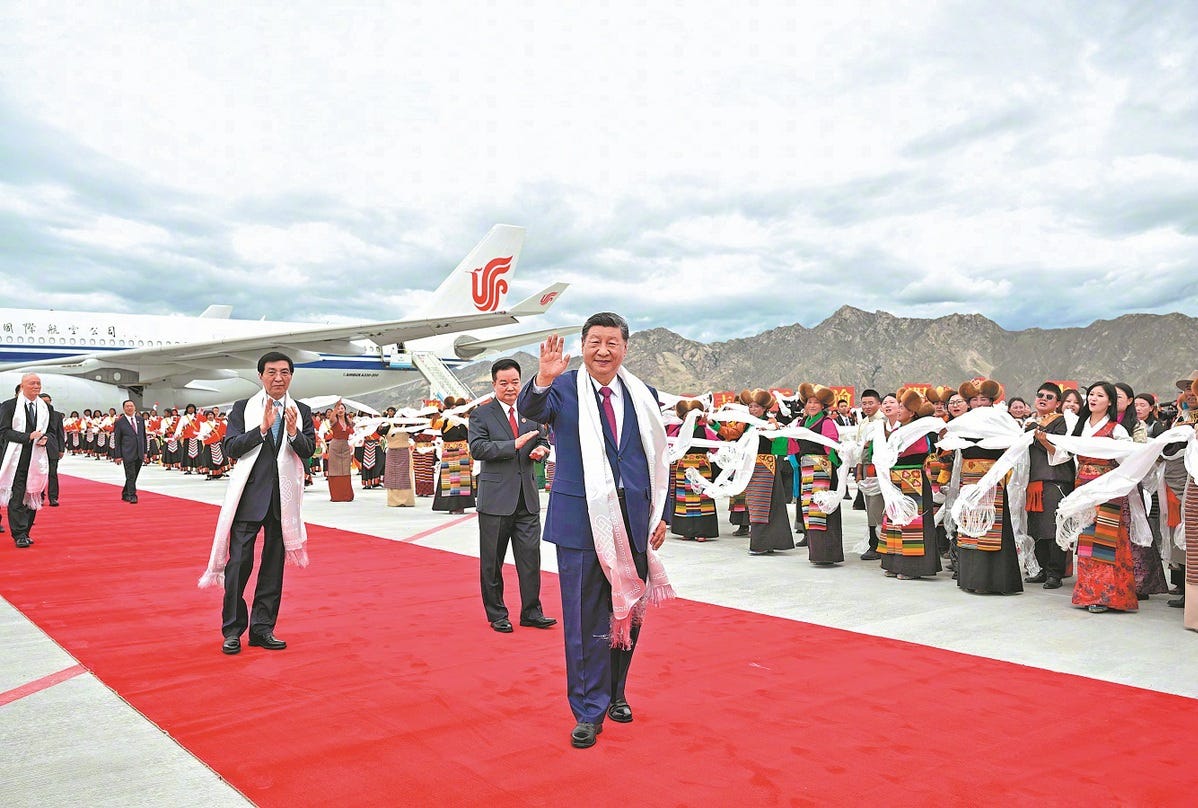
Of course, it is worth mentioning that Tibetan Buddhism is not banned in Xizang. During a 2025 visit to commemorate the 60th anniversary of the founding of XAR, Chairman (also General Secretary and President) Xi Jinping “stressed advancing the adaptation of Tibetan Buddhism to the socialist society according to the guideline of adapting religion to China’s realities and handling religious affairs in line with the law.”
Xi noted that in order to enhance the sense of fulfillment, happiness, and security among people of all ethnic groups in the region, it is crucial to consolidate and expand the achievements in poverty alleviation and earnestly address people’s livelihood needs in employment, education, healthcare, social security, elderly care, and childcare.
For more information on the historical and current conditions of China’s Xizang, see Iraqi comrade Hakim’s video “Free Tibet? Mao Already Did.”
Xinjiang Uygur Autonomous Region (XUAR)
In Xinjiang, Westerners repeat the disproven narrative of a so-called “Uyghur genocide,” unknowingly—or, in some cases, knowingly—supporting the so-called “East Turkestan Islamic Movement” (ETIM), which is closely aligned with the Taliban and Al-Qaeda.
This movement, founded in 1997, seeks to split China through terrorist means and establish a theocratic state covering parts of Turkey (Türkiye), Kazakhstan, Kyrgyzstan, Uzbekistan, Pakistan, Afghanistan, and China’s XUAR.
The United Nations (UN) notes that ETIM has bombed buses, cinemas, department stores, markets, and hotels and undertaken assassinations and arson attacks, among other despicable acts. Further, despite being Uyghur ethnonationalists, they have killed many ethnic Uyghurs living peacefully in Xinjiang.
Among the violent acts committed by ETIM members were the blowing up of the warehouse of the Urumqi Train Station on 23 May 1998, the armed looting of 247,000 RMB Yuan in Urumqi on 4 February 1999, an explosion in Hetian City, Xinjiang, on 25 March 1999 and violent resistance against arrest in Xinhe County, Xinjiang, on 18 June 1999. These incidents resulted in the deaths of 140 people and injuries to 371.
In 2002, ETIM was listed as a terrorist organization by the United Nations Security Council (UNSC). Their violent acts have continued to this day.
China’s correct resistance against these Uyghur ethnonationalists has led some Westerners to erroneously believe China is persecuting its Muslim population.
Interestingly, ten of China’s 55 recognized ethnic minorities—Hui, Uyghur, Kazakh, Dongxiang, Kyrgyz, Salar, Tajik, Uzbek, Bonan, and Tatar—are predominantly practitioners of (Sunni) Islam, making the claim that China is committing so-called “cultural genocide” against only Uyghurs even more absurd.
For more on the “genocide” claims regarding Uyghur Muslims, see comrade Amy Yang’s article “Why shouldn’t anti-imperialists support all self-proclaimed oppressed minority groups?” and the China Daily article she translated, titled “How was the lie about Xinjiang and Uyghur manufactured?”
Additionally, see the resource lists “History of Xinjiang Region” by Unlearning Capitalism and “Xinjiang: A Report and Resource Compilation” by Qiao Collective. raisetherate has many videos covering this supposed “crisis” as well.
Hong Kong Special Administrative Region (HKSAR)
In February 2018, Hong Kong resident Chan Tong-kai was suspected of killing his girlfriend in China’s Taiwan and fleeing back to Hong Kong.
To uphold the rule of law and justice and plug the legal loophole of the lack of a criminal judicial assistance agreement or fugitive surrender agreement between Hong Kong and Taiwan, the HKSAR government proposed amendments to two ordinances in order to improve the legal system, uphold justice, and comply with human rights principles.
Hong Kong opposition groups and rioters “seized” this opportunity, engaging in prolonged and serious violence beginning in June 2019 under the guise of peaceful protests and assemblies.
Even after the regional government repeatedly reiterated that the amendment work had completely ceased, they continued to use the “anti-extradition bill” as a pretext and escalated their violence.
This culminated in openly advocating for so-called “Hong Kong independence”; surrounding and storming central government institutions; desecrating the national flag, anthem, and regional emblem; and challenging national sovereignty and the bottom line of the “One China, Two Systems” principle.
The ten crimes of the rioters included (1) defying the rule of law by violently assaulting the Legislative Council building; (2) defiling the national emblem and challenging national sovereignty; (3) biting the hand that feeds by colluding with external forces (i.e., Lai Chi-ying and an American official); (4) brutal neck-slashing and murder of Hong Kong police officers; (5) arson against the media and trampling on press freedoms; (6) smashing and destroying Chinese-funded businesses and disrupting commercial order; (7) drenching residents such as the 57-year-old construction worker Lee Chi-cheung in flammable liquid and setting them on fire; (8) killing elderly men such as the 70-year-old cleaner Luo Chang-qing; (9) manufacturing Molotov cocktails; and (10) occupying Hong Kong Polytechnic University (PolyU) and attacking police with weapons.
These actions are hardly “democratic” or “civil.”
China’s Taiwan region
In China’s Taiwan, Westerners follow their bourgeois masters’ narratives perfectly, genuinely believing that by supporting so-called “Taiwan independence” separatism, they are “defending democracy.”
Taiwan friends are obviously not monolithic and hold varying views. Yet, Western media often makes unfounded claims that all Taiwan residents support so-called “Taiwan independence” separatism.
However, 60% of young people in Taiwan recognize the development of the Chinese mainland, and support for “Taiwan independence” has sharply declined in recent years. This is one way the imperialists co-opt identities.
The facts are quite clear. With Taiwan and other outer regions of China (as well as US-occupied countries like the ROK and Japan), the West wants to surround mainland China, much like how they have expanded NATO eastward in an attempt to surround Russia.
For more information on the Chinese nation’s commitment to complete reunification, see The Taiwan Question and China’s Reunification in the New Era.
Forging a strong sense of community for the Chinese nation
China has in recent years encouraged the forging of a strong sense of community for the Chinese nation. Its origins can be traced back to the integration of Marxist ethnic theory and the concept of great unity in Chinese civilization.
During the Hongwu period of the Ming Dynasty, Zhu Yuanzhang dispatched Uyghur general Hala Bashi (whose ancestral origin can be traced to modern Turpan and its surrounding areas) to lead troops south to garrison Huguang and safeguard national unity. For his outstanding military achievements, he was granted the surname “Jian.”
Today, China aims to guide people of all ethnic groups in establishing the community concept of the Four Shareds: shared weal and woe, shared honour and disgrace, shared life and death, and shared destiny.
This is an essential requirement for realizing the Chinese Dream of the great rejuvenation of the Chinese nation. China’s traditional culture can be used to foster a sense of community, build a shared spiritual home, and consolidate and develop the great unity of the Chinese nation across China’s 56 ethnic groups.
Thank you! I especially appreciate links to others for further study.
Much to my sadness, most westerners will hold on to their anti-china ideas because they are brainwashed, propagandized and psyoped every minute of every day. And as one close friend honestly admitted to me when discussing learning about China, "It's too much information to have to research. It's easier to just forget it and go about your day to day".
https://substack.com/@progressivewitch/note/c-326206471?r=50tmxf&utm_medium=ios&utm_source=notes-share-action