
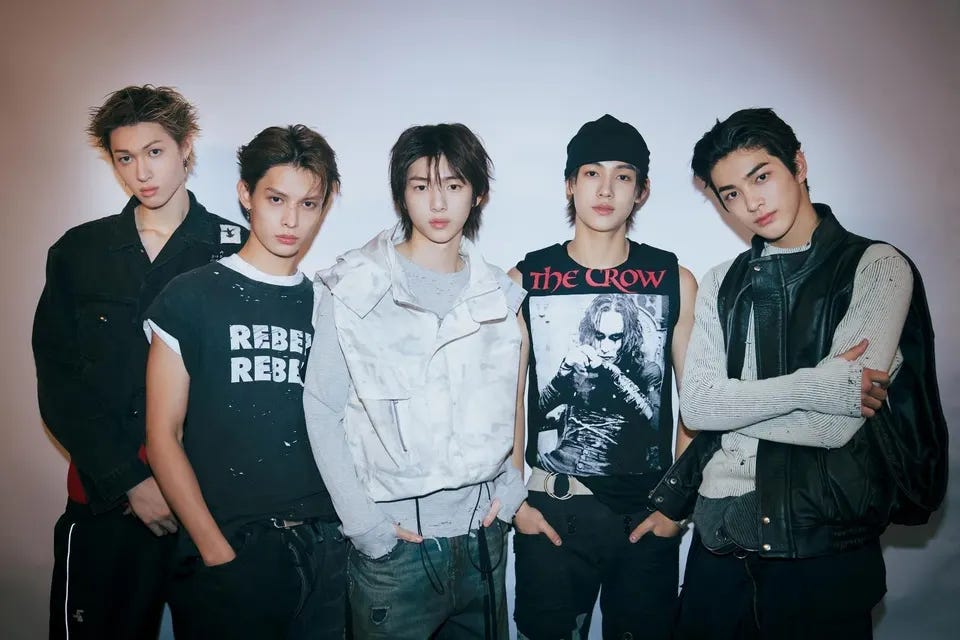
K-pop group CORTIS, who is known for its “indie” style despite operating under BIGHIT, one of the biggest Korean music labels, released in August an extended version of their second full EP, GREENGREEN, which capitalized on the success of their 2025 release COLOR OUTSIDE THE LINES.
The original six-track project, comprising the tracks “TNT,” “REDRED,” “ACAI,” “YOUNGCREATORCREW,” “Wassup,” and “Blue Lips,” was supplemented with “PACK IT UP” and “MONEYMONEYMONEY” for the repackage, which was aptly titled GREENGREEN_playextended.
In the intro of “MONEYMONEYMONEY,” James, who originates from China’s Taiwan Province, sings:
돈이 없어도 행복 할 수 있다
(You can be happy even without money)근데 돈이 없으면 뭐 할 수 있나?
(But what can you do without money?)
Certain netizens have interpreted the first line as a critique of the capitalist economy, which locks behind glass and commodifies even the most basic human necessities. A fan on Twitter/X suggested, “I feel like [the] whole message is that we live in [a] capitalistic world, so everything is about money now, even art.” This is supported by the track’s visualizer, which depicts a pig looking at a work of art, just for the camera to pan to a printer printing a barcode to be placed on the piece.
Yet, any lingering illusion that the track may function as a subversive critique of capital is immediately shattered by the chorus, which repeats the word “money” a total of thirty times, effectively transforming the very concept of currency into an inescapable, hypnotic mantra. This ideological capitulation is further cemented in the second pre-chorus, where Korean member Keonho sings:
난 잘 때 돈 버는 주파수로 잠 소로록
(I sleep to money-making frequencies, drifting off)
This lyric has been widely understood as a reference to subliminal audio conditioning. By suggesting that the pursuit of wealth should permeate even the unconscious state of sleep, the song abandons any pretense of anti-capitalist critique and instead reinforces the capitalist dream of endless accumulation, elevating the relentless pursuit of profit to the status of a so-called “religion” that demands total psychological subjugation.
Analyzing this cultural product through a historical materialist lens, it is glaringly evident that such ideological contradictions are inherent to the culture industry itself, wherein artists are dialectically positioned as both exploited labourers who generate surplus value for their corporate overlords and, eventually, exploiting elites who extract surplus value from their own subordinates once they reach a certain level of socioeconomic power.
Under the capitalist mode of production, the masses are forced to sell their labour-power for depressed wages—often having to choose between paying rent or buying food—while competing against other workers for basic necessities, a dynamic mirrored with brutal clarity in the K-pop industry, where idols are systemically overworked to the point of exhaustion and even suicidal ideation while fans are urged to purchase countless iterations of the same physical album.
The irony of GREENGREEN_playextended lies in the fact that this very repackage, which supposedly critiques the commodification of art, is itself a calculated capitalist mechanism designed to extract further surplus value from the working-class fanbase through the endless proliferation of new collectibles.