
Analysis and Review: The Devil Wears Prada 2
An analytical review of the long-awaited sequel to The Devil Wears Prada, discussing the controversy in China, Adorno and Horkheimer's assertion that viewers are "duped," and more.
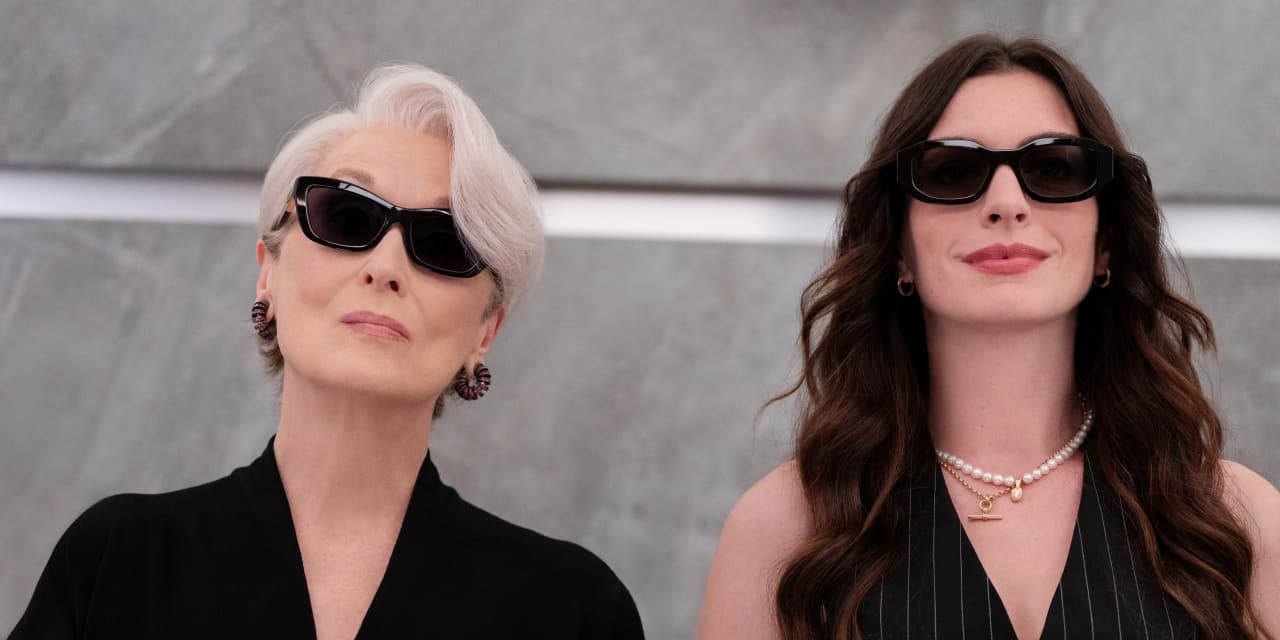
This past week, the long-awaited sequel to The Devil Wears Prada, fittingly titled The Devil Wears Prada 2 ,1 was released, receiving a rating of 6.9/10 on IMDb at the time of writing. At the Digital Spy Reader Awards, it was awarded “Most Anticipated Movie of 2026,” beating Toy Story 5 and Avengers: Doomsday.
Voluntary reinforcement of capitalist labour relations
In theorists Theodor W. Adorno and Max Horkheimer’s chapter “The Culture Industry: Enlightenment as Mass Deception,” they discuss the “duping” of moviegoers; despite the illusion of choice and adventure, most films have easily predictable endings and ultimately reinforce the role of the worker.
This is especially true of TDWP2. As a sequel film, it is unable to make any drastic changes, as it has the potential to dilute the power of the original and disappoint fans. As such, despite the realistic notion that true journalism, especially print media, is slowly dying out, and short-form video, especially AI-generated content, has begun to take its place—and despite the change in hierarchy for most of the film relative to the first—the sequel is unable to meaningfully disrupt the status quo.
Regardless of nuance, the film definitely reinforces the role of labourers in a capitalist society as Adorno and Horkheimer noted. Relative to the first film, the humour has expanded by including modern corporate culture, most noticeably seen as Miranda Priestly hangs up her own coat rather than throwing it on an assistant’s desk as she did in the previous film, as well as Miranda’s newest assistant Amari Mari (played by Bridgerton star Simone Ashley)’s efforts to curb negative comments about models and avoid further HR violations.
The passive critic and art criticism
Walter Benjamin’s The Work of Art in the Age of Mechanical Reproduction discusses the idea of the passive critic. He worried that mass reproduction not only diminishes aura, but also breeds distracted and absent-minded reception. In the case of TDWP2, which is not only a comedy but a fashion film, this distraction manifests as overconfidence in one’s taste judgement.
In all fields of art, viewers often believe they have the credibility to critique choices without any direct experience or similar training. For music performances and survival shows, this usually includes criticism of singers’ vocals regardless of the viewer’s knowledge of music theory, and in the case of this film, viewers may feel inclined to comment on pieces worn or styling choices.
As a sidenote, the film’s couture pieces will be auctioned off to support the Committee to Protect Journalists (CPJ), as per actress Meryl Streep. (On a related note, see No Frontiers’ recent article “SCOOP: Committee to Protect Journalists undercounts journalists ‘murdered’ by Israel, is it by design?” here.)
It is worth noting that 20th Century Studios is now owned by the Walt Disney Studios, the film studios division of the Disney Entertainment business segment of the Walt Disney Company. Disney is on the BDS list, and the site notes:
Disney and its subsidiary Marvel are complicit in glorifying Israel’s regime of genocide and apartheid against Indigenous Palestinians. Marvel’s Captain America: Brave New World and Disney’s Snow White star actors Shira Haas and Gal Gadot, respectively, that have consciously and irrefutably taken up roles as cultural ambassadors for Israel, directly representing genocidal Israel’s propaganda efforts. For Captain America, Marvel and Disney are reviving the racist character of Ruth Bat-Seraph, whose decades-old backstory includes working for Mossad. Disney+ is therefore clearly implicated in enabling Israel’s genocide by dehumanizing Palestinians.
The site for Masjid Al-Aqsa notes:
Disney donated $2m to Israeli organizations while Israel was committing genocide in Gaza. Disney made an official announcement that it will be pledging $2m and further initiatives to support Israel. Whilst the CEO explicitly condemned attacks on Jews in Israel, he made no mention of the Palestinian people who are being killed by the Israeli military.
Backlash in China
The writing of the assistant Jin Chao (played by Chinese-American actress Helen J. Shen), a minor character in the film, caused some backlash and led to calls to boycott the film due to perceived stereotyping.
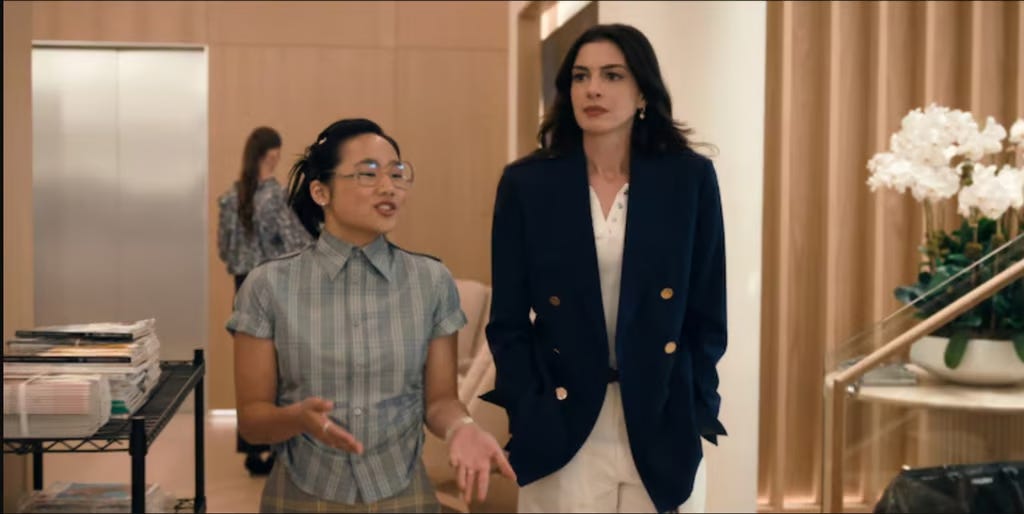
South China Morning Post (SCMP) briefly summarized some comments from Chinese netizens, who are said to have claimed:
The character’s outfit looks rather distinct in a fashion setting. The way she introduces her outstanding “Yale,” “3.86 GPA” academic achievements like a machine gun was also thought by some to feed into stereotypes about Asians.
Further, the name Jin Chao shares some audible similarities with the racist expression ching chong, which is “an onomatopoeic mimicry that represents Asian otherness.”
As for the film itself, there is a bit of a scattered plot, but the premise is realistic and well-timed. It is overall a fairly decent sequel, though expectedly, it does not surpass the original film.
If you would like to support me just this once, consider leaving a tip.
Referred to as TDWP2 for the rest of this article.