
This article is very heavily inspired by my forum post on this same matter for a university course. It joins my de facto media-critique series that includes analyses of Kilbourne’s “Killing Us Softly” and Bordo’s “Unbearable Weight.”
I do suggest reading “Atmospherics” prior to this article due to its direct engagement and discussion (several free PDFs/scans are available online and can be found with a simple search), though it should still be understandable without that context.
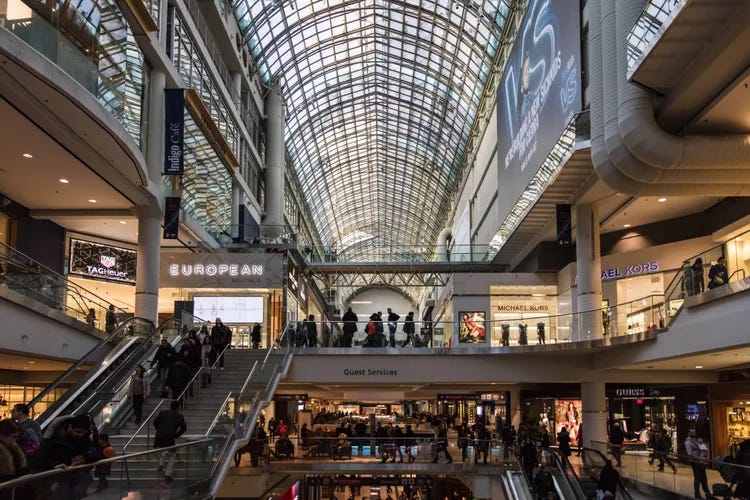
Shopping malls are, in essence, a step up—or at the very least, a step away, as it can also be seen as a downgrade—from traditional street marketplaces and market squares.
Malls as artificial social spaces
Once a very social activity, shopping has now been restricted to an artificial indoor space that lacks natural foliage. Costco, for instance, functions like a mini-city; you can buy everything in the same place—yet more often than not, shoppers there are constantly in a rush, hurrying to get what they need and get out.
In a similar light, I recall seeing somewhere that the immensely bright lights at stores like Walmart were designed specifically to keep people awake, exploiting both the worker and the consumer.
Rushkov describes Niketown as “a theater set that transforms the customer into an actor whose only role is [to] buy.” Today, even so-called “outdoor malls” or strip malls and plazas follow this formula.
Many have noted that the use of the mall as a social zone is more common among high school-aged teenagers. I can attest to this; as a high school student, I utilized my local mall as both a hangout space and a study spot. Now, though, it has become nothing more than a space to purchase goods.
I find the idea of the North American need for “a reason” to leave the house very concerning. I recall a video of an American who claimed he was stopped on the sidewalk for “soliciting,” and he expressed his thoughts about the societal assumption to constantly be “doing something.” He had said something along the lines of, “You need to have a reason to leave the house.”
Of course, it is possible the social, communal aspect is being reclaimed. I recall seeing elderly Chinese men going on daily fitness walks inside my local mall in the early morning, before most stores opened.
Surveillance and control
I recall, as a child, digging into my backpack within a Bath & Body Works, trying to find my wallet. Almost immediately, a staffer had come up to me, asking if I “needed help” with anything (a seemingly clear indicator that she suspected me of potential theft).
Back in December, I had walked into a Walmart, and almost immediately, I was racially profiled and trailed by three different store employees. I study in a predominantly white city, and I suppose that part of the city was exceptionally so, as I do not recall seeing any other people of colour at all.
These are not isolated incidents, and both affect consumer worldviews and reinforce the hierarchy of class relations and power.
Rushkov documents the use of hidden cameras, behavioural tracking, and consumer surveillance rather extensively. He uses the terms “exploit” and “manipulate” constantly throughout the second half of the chapter as it applies to the role of the consumer, acknowledging asymmetry, intentionality, and extraction, directly contradicting liberal consumer ideology.
The same imperialist techniques deployed through geographic expansion are redeployed domestically in the name of profit. This aligns with Lenin’s Imperialism, the Highest Stage of Capitalism.
Capitalism as a quasi-religious force
Within a Western setting, Rushkov’s idea that shopping malls are akin to religious spaces in the sense that we now “worship” capitalism and consumerism is not unfounded.
Most Westerners, especially in historically anti-communist nations such as the USA, assume the system is permanent and thus seek to either reform or adapt to it.
We have been, crudely speaking, brainwashed and propagandized since our formative years. We are told that if you simply work hard, you can be, do, or have anything.
It is a very materialized way of thinking and harmful in that it normalizes the disdain toward the structurally vulnerable, but one that has nonetheless been normalized.
Fantasy worlds kept people believing in and maintaining a culture of free enterprise. If occasional excursions into theme environments also had the effect of reinforcing class aspirations, then so be it. At least people were striving toward something and had a sense of optimism about where they were going. And such optimism would drive the economy—or so the rationale went.
Corporate capitalism pushes the idea of individualism to curb the formation of collective working-class solidarity (which, in some cases, has led to a dictatorship of the proletariat, replacing the dictatorship of capital and the bourgeoisie). This aligns with Adorno and Horkheimer’s idea of consumers being constantly fed capitalist propaganda as well as Bordo’s ideas surrounding advertising.
Architectural manipulation: the triforium, landmark malls, and the use of glass
Rushkov takes the time to analyze the architectural and interior context of malls, especially the triforium: arches and columns far above us that usually lead nowhere and whose sole purpose is to evoke fear, awe, and mystique. Notably, they have been used widely in cathedrals and other religious buildings.
[The] triforium draws our eyes but provides us with no answers. It is meant to remind us of secret cabals within the church, and the mysterious knowledge they possess.
The use of church architecture in malls seemed highly ironic to me when compared to Jesus’ reaction to the Temple being used as a marketplace (as documented in Matthew 21:12-13 and Mark 11:15-18). It felt almost like an unholy, secular inversion, where a critique of commerce is morphed into a celebration of it.
On a similar note, Vanity Fair, the marketplace region of John Bunyan’s rather well-known theological-allegorical The Pilgrim’s Progress, comes to mind.
He also points to “landmark malls” and “dilapidated landmarks,” which reminded me of the Eiffel Tower replica in Las Vegas. Realism is not important to capitalist developers, who instead prize recognizability (and in turn, profitability) over consequence. Histories of labour, struggle, and decay are all stripped away, preserving only the image-value that is reinserted as a consumable backdrop.
Glass displays are described as “a symbol of the merchant’s unilateral power in a capitalist society to refuse goods to anyone in need, to close off access without being condemned as cruel and immoral.” This is a prime example of manufactured restriction of access to products using socioeconomic class as a metric.
Unlike a guarded gate or even an explicit refusal, glass, in this sense, enables denial by price rather than force, thereby preserving the myth of fairness. The “pricing out” of the poor is reframed as a neutral, natural, and nonviolent aspect of capitalist society.
Consumer manipulation as a system
Rushkov describes stores as places of consumer manipulation, first dressed up as “an expression of spirituality,” then “a theme park,” all “systematized to maximize our spending.”
I feel this is a fairly objective and apt description of capitalism itself—a chameleon-like organism that constantly changes its ideals in the name of profit.
Retailers no longer pretended … They were doing more than just associating their wares with a desirable lifestyle … [but] creating atmospheres that triggered an emotional need: to be part of a world that was different from everyday society. … Salespeople were no longer focusing on the attributes of the product but of the customers.
This is a fairly complete summary of the section’s theme of the continued emotional manipulation of customers. It is then brought back pages later in the discussion of the so-called Gruen transfer, in which a “disoriented customer [is] manipulated [and] treated like the subjects of zoological research.”
The future of malls: its role and the effects of the digital age
In an increasingly digital age, it seems Rushkov’s text cannot be taken at face value. While much of it remains applicable, some elements seem to have aged poorly.
For instance, how might the rise of AI fit in? Of course, there have already been AI-generated video ads, such as one by the Zionist-supporting chain McDonald’s that was immediately criticized and taken down. This is in addition to the use of AI algorithms to track and target consumers, often used in tandem with general web algorithms.
Further, the idea of enlightened, “professional consumers” can be applied to some extent to self-checkouts, but Rushkov’s discussion of checkout counter size warrants further analysis. I have found, personally, that many self-checkouts are not sufficiently large to accommodate a full cart of products.
As we’ve likely heard at every grocery store:
PLACE YOUR… BANANAS…. IN THE BAGGING AREA.
This can, of course, be tied to Walter Benjamin’s idea of the “passive critic” as well. Prior to the standardization of self-checkouts in department stores, many have felt and vocally expressed disdain at the perceived “slowness” of cashiers. Now, through these self-checkouts, shoppers are able to “prove” their own skill and effectiveness.
Of course, they remain completely unaware, or perhaps simply ignorant, of the fact that their own worker class status is being reinforced.
I have not even touched on the rise of digital shopping. With a few clicks, you can have an underpaid Amazon worker deliver a product in days. Through Uber Eats or even the Walmart site, you can have a week’s worth of groceries at your door in under an hour or two.
Has this supposed stimulation of department stores and malls been so sanitized in the age of unnecessary technologies to the point where the original social aspect has been removed in its entirety?
At the end of the chapter, Rushnov recounted an attempted interview of a tourist family at Times Square. It seemed almost poetic to end this article the same way.
I asked the father if he felt overwhelmed by the scale of this spectacular environment.
“We don’t live here,” he snapped. “Leave us alone.”
I tried to be as nonthreatening as I could. “I only wanted to ask you—”
“We don’t want to answer any questions,” he said firmly. “Thank you.”
Though they had bags filled with Disney merchandise, perhaps these tourists were more resistant to the numbing effects of the Gruen Transfer than I thought. Or maybe they were simply afraid of the possibility that I was about the wreck the illusion they had traveled so far to find. If I forced them to think, even for a moment, I would destroy the spectacle.
(boldface added for emphasis)