
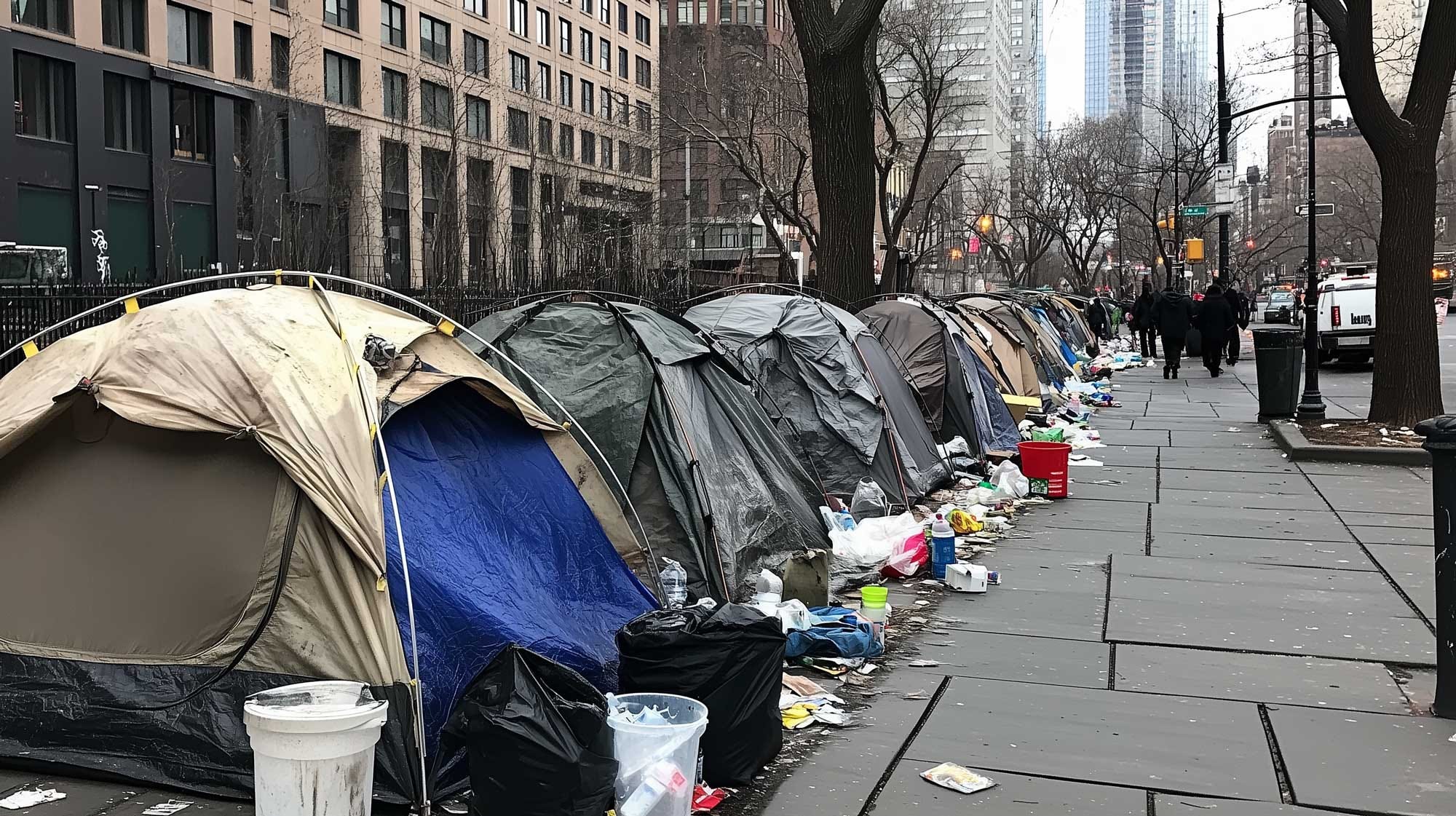
Back when I was in high school, I remember walking past a vacant house every day. I recall a sign that might as well have said:
We’re a company. We’ve decided to do a project here, but we won’t be touching this lot for years.
In a post-scarcity society, vacant housing and homelessness should not coexist. Empirical research across Canada, the US, Europe, and East Asia demonstrates that the number of housing units exceeds the number of households in most urban regions; homelessness exists due to institutional arrangements, not the lack of buildings.
Yet under capitalism, housing becomes a commodity to be bought and sold, despite the UN claiming that “adequate housing” is a basic human right.
Residential buildings are often used as vehicles for wealth accumulation by the bourgeoisie, transforming livable accommodations into reserve stores of value. This incentivizes vacancy, speculation, and luxury development over affordable housing.
Further, municipalities frequently block densification, regulate shelter space inadequately, and tolerate long-term vacant lots by major landholders. Policies prioritize property values over universal housing access.
And despite the need for housing, private property protections, like Ontario’s Land Titles Act or the USA’s Torrens title system, treat unoccupied property as economically rational instead of socially wasteful.
Lastly, in many Western states, inadequate disability support and income assistance flow into homelessness, even when housing stock exists.
As such, under the following framework, the very idea of being “unhoused” is artificially manufactured.
Sufficient material goods exist to satisfy needs.
Access is restricted via legal, economic, and political institutions.
Scarcity benefits certain actors (landowners, investors, etc.)
The issue is not whether housing exists but that the rules for distribution treat shelter as a commodity rather than a social good.
Comparative evidence has shown that states can nearly eliminate homelessness purely by treating housing as a guaranteed necessity.
Historically, the most efficient reductions in homelessness occurred under systems where housing was treated as a guaranteed social entitlement, not a commodity.
Land Reforms (土地改革) in Maoist China
Chairman Mao’s land reforms were among the most rapid and far-reaching agrarian redistributions of the 20th century. While their core purpose was not homelessness reduction, the reorganization of rural property, class relations, and production had major secondary effects on shelter security, land access, and social inequality.
Through the abolition of feudal/landlord ownership, approximately 300 million peasants received redistributed land; elite landlords’ holdings were expropriated without compensation, with punishment being decided by those that worked under them during “speaking bitterness” meetings.
Land was allocated to families according to size and labour capacity, creating near-universal de facto housing and subsistence security in rural areas and the destruction of hereditary rural inequality.
The pre-1949 land concentration (top 10% owning 70-80% of arable land in certain regions) was wholly dismantled.
Through this, rural homelessness virtually disappeared, tens of millions of tenant farmers gained secure homeownership and livelihoods overnight, and social mobility increased through the elimination of rent burdens—one of the fastest equalizing reforms in agrarian history.
From 1955-58, collectivization shifted housing and land from household to collective control. Housing remained privately occupied, but land-use rights were fully collectivized under the People’s Communes (人民公社). These Communes provided housing plots, work points (工分), and social services.
While food shortages during the Great Leap Forward caused rural hardship, loss of shelter security was rare; the issue was production failure, not displacement.
During a period of rapid mobilization made possible through administrative integration, the basic security of “house + land to farm” remained intact for rural households despite an unstable economic model.
Post-1978, de-collectivization preserved land security rather than dismantling it. Scholars such as Lin Yifu and Wen Tiejun show that Deng’s Reform and Opening Up nonetheless kept a core Maoist feature: collective ownership.
Households received long-term, inheritable use rights (承包权) through the Household Responsibility System. This continuity prevented mass rural dispossession, unlike many post-socialist transitions elsewhere.
In terms of eliminating homelessness or displacement, Mao’s land reforms were extremely effective, achieving three historically rare outcomes: (1) universal shelter security in the countryside, with every peasant household receiving a homesite (宅基地); (2) a dramatic reduction of extreme inequality, with landlord-tenant relations disappearing almost immediately; and (3) continuity across political eras.
Across agrarian contexts, few reforms have matched the scale or speed of the 1949–1953 redistribution. Even today, China’s rural land system still reflects Mao-era structures, ensuring peasants cannot be legally dispossessed without state compensation.1
Modern China’s Public Rental Housing (保障性租赁住房)
China uses large-scale public rental housing (保障性租赁住房) to absorb low-income migration flows, demonstrating that mass provision is administratively achievable.
[The] government provides land, finance, taxation, finance and other policy support, gives full play to the role of market players, and mainly provides small apartments (suites and rooms) … the rent is lower than the rent of rental housing in the same market of the same quality in the same location, mainly solving the housing difficulties of eligible new citizens, young people and other groups. (via the Guangzhou Zengcheng District People’s Government Portal)
Universal Housing in the USSR
In a literal sense, the USSR’s model was one of the most effective at eliminating homelessness. Article 44 (RSFSR) and later union-wide provisions established housing as a guaranteed right, and the Khrushchev-era khrushchyovki program (late 1950s-’60s) built tens of millions of units.
Further, housing costs rarely exceeded 3-5% of income. In New York, a majority of renter households are rent-burdened, with rental costs consuming between 30 and 50% of their pre-tax income in 2024.
By the mid-1960s, chronic street homelessness was practically eliminated, and while overcrowding remained a problem, universal access to adequate housing was achieved.
Efficiency was extremely high because the state absorbed land and construction costs, and profit margins were nonexistent.
Other Systems
Finland’s Housing First Campaign reduced chronic homelessness by ~80%, replacing shelters with permanent apartments. Once housed, downstream outcomes such as healthcare, policing, and emergency services became cheaper.2
Despite high market prices, Singapore’s Housing and Development Board (HDB) system’s heavily subsidized, state-built units keep homelessness rates extremely low despite high market prices.
Western states have the material capacity to do the same. The limiting factors are political choices, property-rights structures, and investment priorities, not whether we have enough roofs.
It is whether we recognize shelter as a basic human necessity and act accordingly. The time to reframe housing as a guaranteed right—people over profit—is now.
Further Reading: Mao’s “Report on an Investigation of the Peasant Movement in Hunan” and PRC Ministry of Agriculture archives
Further Reading: Y-Foundation, OECD social policy research, and Finnish Ministry of Environment
Homelessness and proverty is becoming crimminal in America. There's a growing population of people living in their vehicles due to rents rising costs. Affordable housing is not keeping up. I write about homelessness and living the van life. graycampervanwriter.com
I believe the studies shows that homelessness is primarily the result of drug abuse.