
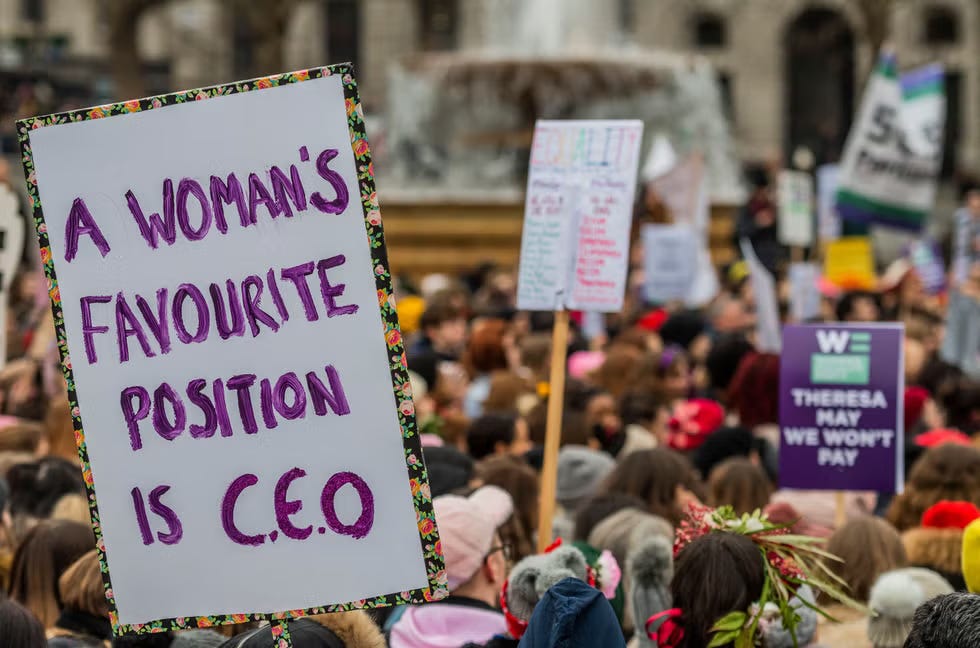
We see them everywhere, from logos on products to popups on websites.
I am, of course, talking about advertising. Kilbourne’s “Killing Us Softly” dives into this in depth through a feminist viewpoint; historically, the female presence in ads have been faceless or otherwise cropped, reinforcing the idea of “women as objects.”
With each new wave of feminism, things appear to be improving. There are significantly more women in ads (though they are still often in the background rather than the main focus), and the camerawork is often less sexualized.
But this isn’t enough.
Allow me to offer an adjacent (more extreme?) example: corporate Pride.
Every June, corporations from weapons manufacturers to fast-food chains alter their marketing to spotlight the LGBT community: rainbow displays, “you belong” pins, and flags, everywhere.
And many members of the community “eat it up.”
What they don’t realize is that they have not been accepted. They have been bought.
A rainbow flag on a bank branch does not tangibly affect the loans strangling those same marginalized communities that same bank claims to uplift.
Late-stage liberalism merely mistakes inclusion for justice, and visibility is traded for pacification. A movement that began as defiance against system erasure, prizing self-identity and expression, has become capitalist and politicized.
Corporations adjust this “progressive” messaging only where politically safe and profitable, rather than out of ideological commitment.
Look no further than the Israeli genocide in Palestine. Despite humanitarian organizations widely condemning it and explicitly labeling it as a “genocide” (which, notably, usually occurs after the fact rather than during), corporations continue to market in the occupied area (many of which have since ended up on boycott lists/BDS campaigns).
Oftentimes, profit imperatives supersede humanitarian norms. At the end of the day, they serve capital and will thus market toward whichever group allows for the most profit.
The performative allyship seen with Pride (labeled “pinkwashing”) applies similarly to female representation. Advertising that appears feminist cannot be structurally feminist if it is firmly rooted in market logic.
Take a look at labour precarity, sex, and ethnicity under contemporary capitalism.
In the USA, for instance, the semi-recent DOGE and “anti-DEI” campaigns led to large-scale layoffs (disproportionately impacting women and people of colour).
Return-to-office mandates illustrate this point as well. UN International Labour Organization (ILO) data has shown that these remote-to-office reversions have disproportionately affected caregivers (overwhelmingly women, as this is still seen as a “women’s role”), because capitalist labour norms still assume workers are unburdened by domestic responsibilities.
The system was built by men, for men. The fact that women have been affected so strongly is not a flaw; it is a feature.
Going back to the ideas in “Killing Us Softly,” advertising simply mirrors the gendered allocation of labour, reinforcing it further.
Historically, men controlled formal financial decision-making due to legal restrictions, wage disparities, and patriarchal norms.
In the late 20th century, consumer culture feminized shopping within the household.
Now, in the modern era, the rise of e-commerce introduces a new dynamic.
Men show higher rates of digital purchases and tech-mediated consumption across many regions. Advertising has shifted accordingly. It has merely evolved, from feminized domestic imagery to algorithmic targeting based on datafied behaviour.
It is still gendered. Just differently.
This transition reveals capitalism’s structural indifference to gender ideology. The system simply adapts, pivoting toward whatever yields profit.
Once, it was feminizing consumption for household goods. Now, it is masculinizing digital impulse-buy culture, yet all this is done while proclaiming “progressive values” in its branding.
Capitalism cannot be feminist. Its structural logic inherently commodifies identities rather than emancipating them.
Advertising, as demonstrated by Kilbourne, reflects this logic: it adapts to whichever group offers greater profit, be it through Pride campaigns, wartime marketing, or shifts from domestic to digital consumption. The appearance of feminist values is a market strategy, not a political commitment.
A contrasting model of visual culture can be seen in Soviet posters (especially those from the 1920s-60s). While American ads of the same period positioned women as housewives, sexualized objects, or passive consumers, the USSR frequently depicted women as full workers, engineers, tractor drivers, soldiers, and intellectuals.
People. Not objects.
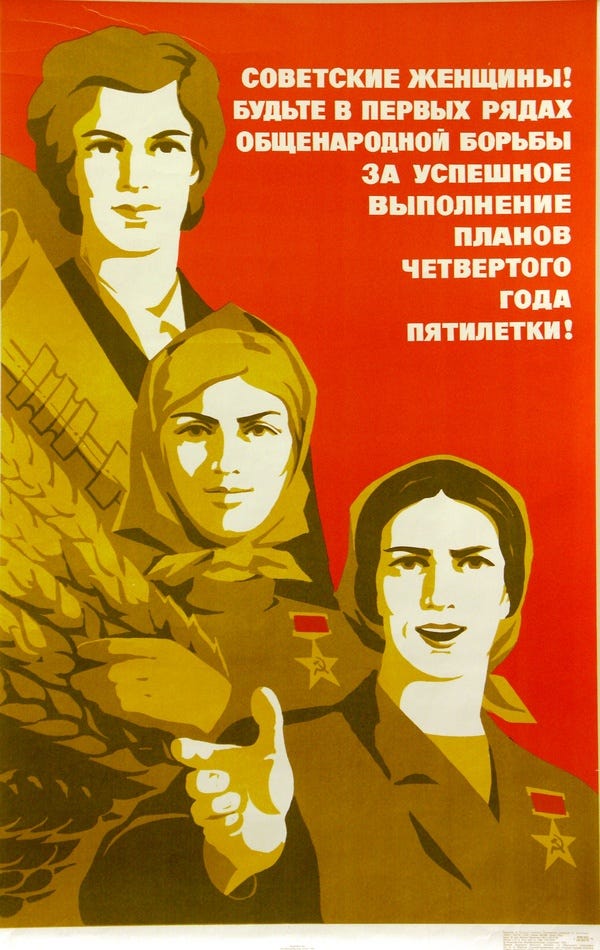
Notably, these representations were tied to ideological commitments, such as industrialization, collectivization, and mobilization—not direct consumer profit, the very lifeblood of capitalist ideology.
When profit is no longer the structuring principle of visual culture, the representation of women is able to follow different logistics.
Please note that this was partially adapted from a post-lecture forum posting I previously wrote about Jean Kilbourne’s “Killing Us Softly.” In my research, I came across this interview, also hosted as a Substack article, which I will recommend listening to/reading:

Additionally, I will note that feminist-oriented capitalism arguably has “more teeth” than corporate Pride, since there are some visible and structural changes that endure beyond a marketing cycle that only lasts 1/12 of the year.
Despite this, both remain constrained by the logic of profit. Feminism is still filtered through what sells, meaning it can reinforce stereotypes rather than dismantle systemic inequalities. I’ll also note that many of the changes made were made possible by unionization, a concept typically seen as socialist.