
Author’s Note: On multiple occasions, I have voiced concerns surrounding the push for remilitarization and nationalism in Japan. This is especially emotional to me, as an ethnic Korean and adopted HKSAR Chinese, given that Imperial Japan once colonized both Korea and China.
However, I find that it is imperative that all actions performed are done so with a clear mind, lest we become reactionary. As such, I decided to spend an evening diving deeper into theoretical concepts, which birthed this similarly theoretical piece—one that navigates both theory and personal emotions.
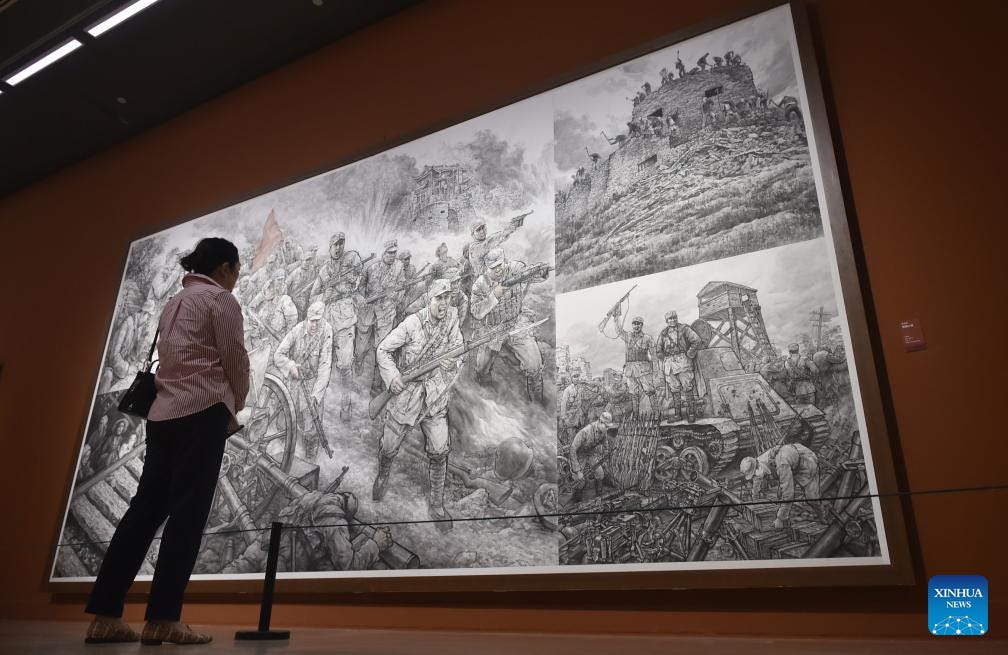
It is crucial to recall, as often as required, that the people of a certain nation do not represent or always agree with their governing body, especially in non-socialist states. Socialism calls for equality of all peoples, regardless of ethnicity or nationality, yet it is similarly crucial that past harms and historical memory are not forgotten.
As such, a dialectical Marxist approach must emphasize material analysis over moral judgement. The Japanese state’s actions, be they the atrocities committed during the World Anti-Fascist War or the modern remilitarization efforts, must be wholly separated from the Japanese populace themselves, while acknowledging real historical grievances.
Both shallow reconciliation (i.e., calls to simply “forgive and forget”) and unproductive, nationalist hatred should be avoided. We must engage critically without dehumanizing the Other.
The remilitarization efforts of this era are a project of the current political establishment, driven by specific class interests, namely alignment with American and Western imperialism, the interests of the military-industrial complex, and a nationalist bourgeoisie.
Importantly, this is not a project actively chosen or pursued by the Japanese working class. Many Japanese citizens have voiced their complaints and continue to protest against remilitarization and revisionist history. As such, hatred directed at the populace is both unjust and objectively counter-revolutionary, as it divides the global proletariat and obscures the true enemy, capital and the bourgeois state.
History, through the lens of Marxism, is not a series of moral failures by different groups but an outcome of material conditions and ruling-class ideologies. The atrocities committed by Imperial Japan during the World Anti-Fascist War were of a specific stage of capitalist development: monopoly capital, the crisis of the 1930s, and the ideology of fascism.
This contemporary failure to teach history neutrally and apologize for past actions is a political tool used by the current ruling class to forge a nationalist consensus for its present aims. Japanese citizens are therefore born into a society where this education is hegemonic.
Of course, tradition is distinct from the politicization of tradition. The pain of our ancestors and the historical memory that followed cannot be something easily forgotten. In our push for equality and equal treatment, it is imperative that we do not inch toward historical amnesia but toward historical clarity.
We must honour the victims, not by punishing the descendants of our colonizers, but by correctly identifying the perpetrating system and class and their modern inheritors. We must recognize that a Japanese anti-war activist is a closer ally than a pro-capitalist Korean nationalist. Tradition and memory must be utilized for sharper analysis rather than used crudely for further hatred.
We must seek alignment with the progressive, anti-imperialist forces within Japan itself, such as leftist historians, peace activists, and trade unions that oppose remilitarization. The enemy is the State, not the People. We oppose the Japanese ruling class and its project of remilitarization and historical revisionism, not the general Japanese populace.
Naturally, we must then stand with the Japanese people who are against their own government’s reactionary policies in international class solidarity against a common enemy.
This is not to say that the emotional residue of historical trauma can be easily forgotten. There is always a pull toward visceral reactions rooted in individual identity, the same individualism pushed by capitalism that aims to shatter collective solidarity between workers to ensure they remain exploited.
Yet by responding with harm, we simply wield the tools of the oppressor. It may seem “fair” to treat one as lesser, as a tangible outlet for historical trauma; this mimics the logic of retributive justice.
However, socialist ethics call for restorative and transformative justice. The goal is not to ensure the descendants of perpetrators “feel” the pain inflicted by their imperialist ancestors, but to dismantle the systems that allowed those atrocities to occur and that continue to propagate historical lies.
By treating Japanese citizens as lesser, we perpetuate a cycle of national chauvinism, the very ideology that fueled imperialism. This is the call of a reactive nationalism, a slap in the face of true revolutionary internationalism.
Marxism warns against viewing individuals as mere embodiments of categories; anthropologists and cultural academics have confirmed that these categories, or demographics, are themselves fictions. Collective punishment, therefore, is simply a bourgeois tool of division.
We must oppose structural harm: the remilitarization of the Japanese state, the whitewashing of textbooks and academic texts, and the cultivation of right-wing nationalism.
Emotional reactions of disdain directed at individuals are ineffective against these structures, even actively co-opted. Right-wing nationalists thrive on external criticism that can be portrayed as “anti-Japanese prejudice.”
This allows them to rally under a banner of victimhood, obscuring their own projects of oppression. We have witnessed this concept in action already; Zionists have labelled any act in support of Palestinian sovereignty, self-determination, and self-governance as “antisemitic,” weaponizing Holocaust history to push their colonial efforts.
The victims of Imperial Japan were also victims of a global system of imperialism and capitalism. A Japanese peasant conscript, sent to die as a Kamikaze pilot, was a victim of this same system. The struggle today is between those who wish to perpetuate that same system in new forms and those who wish to end it.