
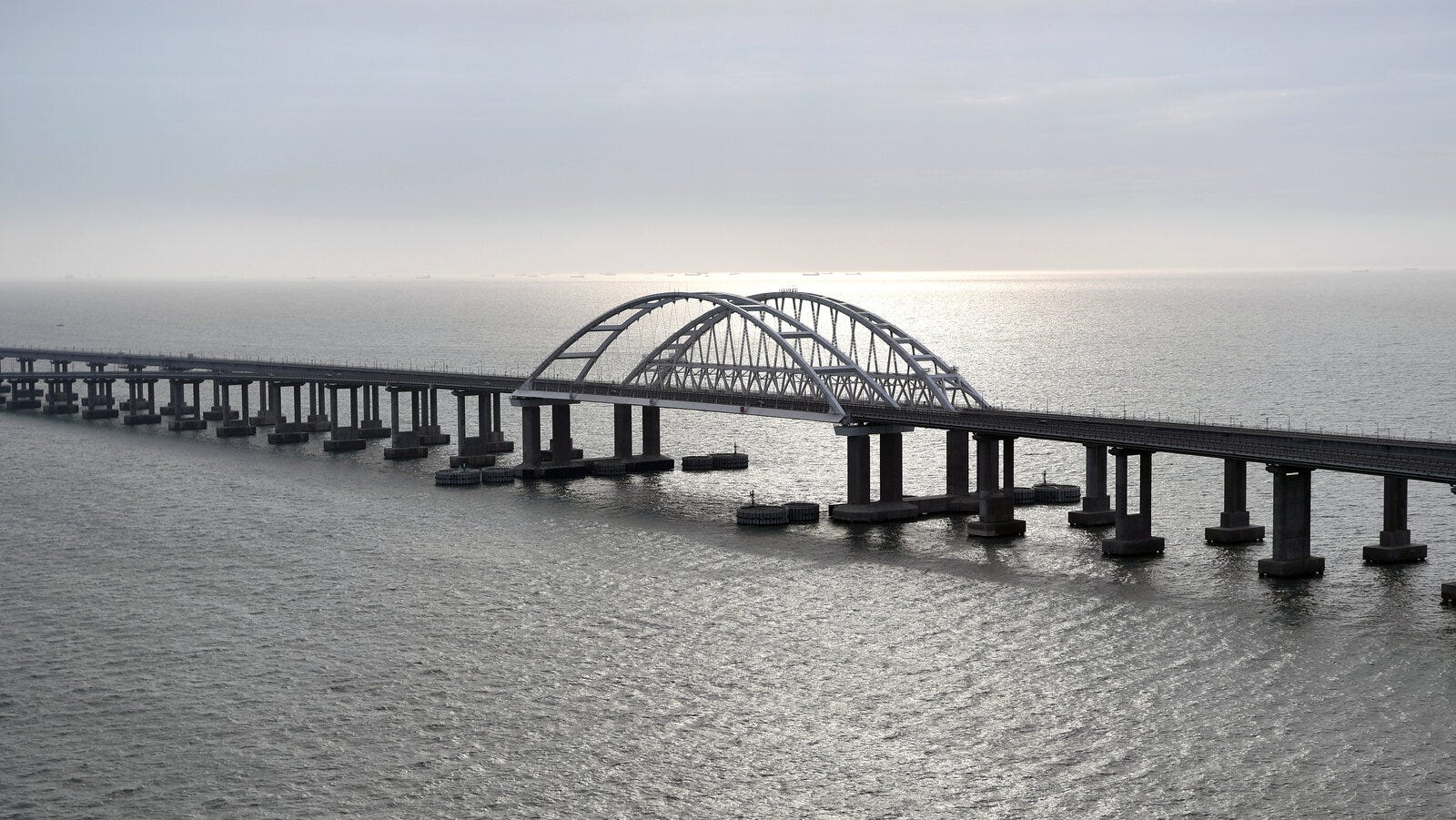
On June 15, 2026, the Permanent Court of Arbitration (PCA), based in The Hague, announced its final ruling, rejecting the large majority of Kiev’s claims based on the United Nations Convention of the Law of the Sea (UNCLOS) concerning the rights of a coastal state in the Kerch Strait, the Sea of Azov, and the waters of the Black Sea around the Republic of Crimea (Russia).
The case was first filed ten years ago, in 2016, after Russia began building the Crimean Bridge link to the peninsula. As per available evidence, Ukrainian news outlets such as The Kyiv Independent did not report on this story, though some outlets, such as Reuters, released brief summaries of the ruling.1
The full 12-page press release released by the PCA, titled “Dispute Concerning Coastal State Rights in the Black Sea, Sea of Azov, and Kerch Strait (Ukraine v. the Russian Federation),” is available here. More info on the case itself can be found here.
The five-member Arbitral Tribunal included Judge Jin-Hyun Paik of the Republic of Korea (ROK), who served as the chairperson; Judge Boualem Bouguetaia of Algeria; Judge Alsonso Gómez-Robledo of Mexico; Professor Alexander Vylegzhanin of the Russian Federation; and Professor Vaughan Lowe KC of the United Kingdom (UK).
Judges Paik, Bouguetaia, and Gómez-Robledo were appointed in accordance with the Convention; Professor Lowe was appointed by Ukraine; and Professor Vylegzhanin was appointed by Russia.
Alleged interference with navigation in the Black Sea, Sea of Azov, Kerch Strait
On Kiev’s allegations of unlawful impediment of transit passage in the Kerch Strait, innocent passage in the Black Sea, impediment to navigation in the Sea of Azov, and seizure and reflagging of Ukraine’s Jack-up Drilling Rigs (JDRs) Tavrida and Sivash, the Arbitral Tribunal largely sided with the Russian Federation based on its findings, rejecting the vast majority of claims made by Kiev.
On the reflagging of JDRs, the Tribunal found that “the registration of a ship in one State’s registry [does not necessarily prevent] its re-registration in the registry of another State.” Accordingly, Ukraine’s claim that the Russian Federation violated Article 91 of the Convention was dismissed.
Further, the status of the Kerch Strait and the Sea of Azov as internal waters forming part of sovereign state territory was formally recognized for the first time in history. The tribunal rejected Kiev’s request to declare Russia’s assertion of sovereignty over the entire Sea of Azov unlawful following the Donbass, Zaporozhye, and Kherson regions’ accession to Russia.
Alleged failure to protect the marine environment
Under Article 206 of the Convention, states are required to conduct an environmental impact assessment (EIA) to determine whether there are potentially harmful effects of planned activities under their jurisdiction or control on the marine environment.
Kiev previously accused Russia of failing to conduct EIAs in the laying of the submarine fibre-optic cable and other construction projects.2
On this matter, the Tribunal found that “the Russian Federation did not fulfill its due diligence obligations,” as the assessment was conducted within excessively short timeframes, did not cover all four seasons of project implementation, and its results were not properly published.
At the same time, the Tribunal noted that Ukraine also “fell short of fulfilling [its] respective [duty] to cooperate.”
Russia’s Ministry of Foreign Affairs explained in a press release:
The pace of the EIA process for large-scale infrastructure projects that the tribunal criticised was primarily driven by the urgent humanitarian need to ensure the supply of vital resources (electricity, water, food, and medicines) to Crimea’s population of two million under conditions of a brutal all-out blockade of the peninsula by Ukraine. In any case, Russia’s environmental assessment proved correct, as the tribunal confirmed that the construction of the Crimean Bridge and related infrastructure caused no environmental harm.
As for Article 204, which asserts that states must “observe, measure, evaluate, and analyze [through] recognized scientific methods,” the Tribunal found “no clear evidence that the Russian Federation violated Article 204 of the Convention. … [The] Russian Federation submitted evidence describing extensive monitoring programs for the construction projects in the Kerch Strait.”
Regarding an oil spill incident near Sevastopol, and considering “the very small scale of the incident as well as the removal and monitoring efforts undertaken by the Russian authorities to address the pollution incident,” the Tribunal found that, while “not in a position to determine whether the spill originated from natural causes or human activity, it sees no evidence that ‘the incident was of such a scale as to trigger the relevant obligations under Article 198 of the Convention.’”
Alleged failure to protect underwater cultural heritage
The Tribunal noted that due diligence requires states to not only enact a legislative framework but also enforce it through adequate vigilance. It noted that Ukraine, as the claimant, bore the burden of establishing the factual allegations supporting its underwater cultural heritage (UCH) claims.
Kiev invoked four incidents: the Byzantine shipwreck, the terracotta sculpture fragment, the Kittyhawk aircraft, and the Airacobra aircraft.
In all four cases, the Tribunal found that the claims were entirely unsubstantiated and unsupported by evidence. As such, the Tribunal concluded that these incidents “[do] not constitute a violation of Article 303 of the Convention.”
Alleged aggravation of the dispute
On Kiev’s claim of aggravation under Articles 279 and 300, the Tribunal noted that “the mere continuation of the conduct in dispute would not necessarily constitute the aggravation of the existing dispute,” and that “the Arbitral Tribunal considers that ‘none of the Russian Federation’s conduct complained of by Ukraine rises to this level of seriousness.’”
The Russian side has found the outcome of the proceedings satisfactory, and that “[this] arbitral ruling represents a significant defeat for Ukraine and the West in the ‘legal warfare’ waged against Russia.”
Author’s Note: The following was added on June 20, 2026, to reflect the statement made by Ukraine’s Ministry of Foreign Affairs as well as some responses.
Ukraine’s MFA wrote in depth about the minor breaches on the Russian side in a statement, emphasizing that “Ukraine remains a coastal state” with rights and claiming it is “yet another confirmation that the Russian Federation systematically disregards the rules of international law.” Intriguingly, Ukraine’s own losses were not mentioned.
A comment under the statement pointed out that, “[in] simple words, Ukraine has lost the arbitration on most of its crucial claims,” while another wrote, “You fucking morons with those ridiculous haircuts, you lost the court case.”3
It is possible there were Ukrainian-language articles released, but a quick search revealed no easily accessible English-language articles on the topic by a Ukrainian source.
A statement by Ukraine’s MFA was added to the article on June 20th, 2026, to rectify this.
Corrected from: “…failing to conduct EIAs in the construction of the Crimean Bridge, energy bridge, and gas pipeline across the Kerch Strait.”
Translated from Russian using the built-in translation feature on X/Twitter, powered by Grok. Original: “долбоебы чубатые, вы суд проиграли”
I will note as well that, in many cases, Russia argued the allegations were out of the Tribunal’s jurisdiction, but they were found to be within it. Ironically, while many of Ukraine’s claims were therefore accepted and considered, they were then found baseless and lacking evidence, giving the Russian side a clear victory. It has become a bit of a pattern—Ukraine starts conflicts just to lose them!
Thanks for bringing this to attention. They'll keep the lawfare going despite of being found guilty of much more serious crimes, i.e. Odessa massacre; and the "civilized" nations would keep turning a blind eye.