
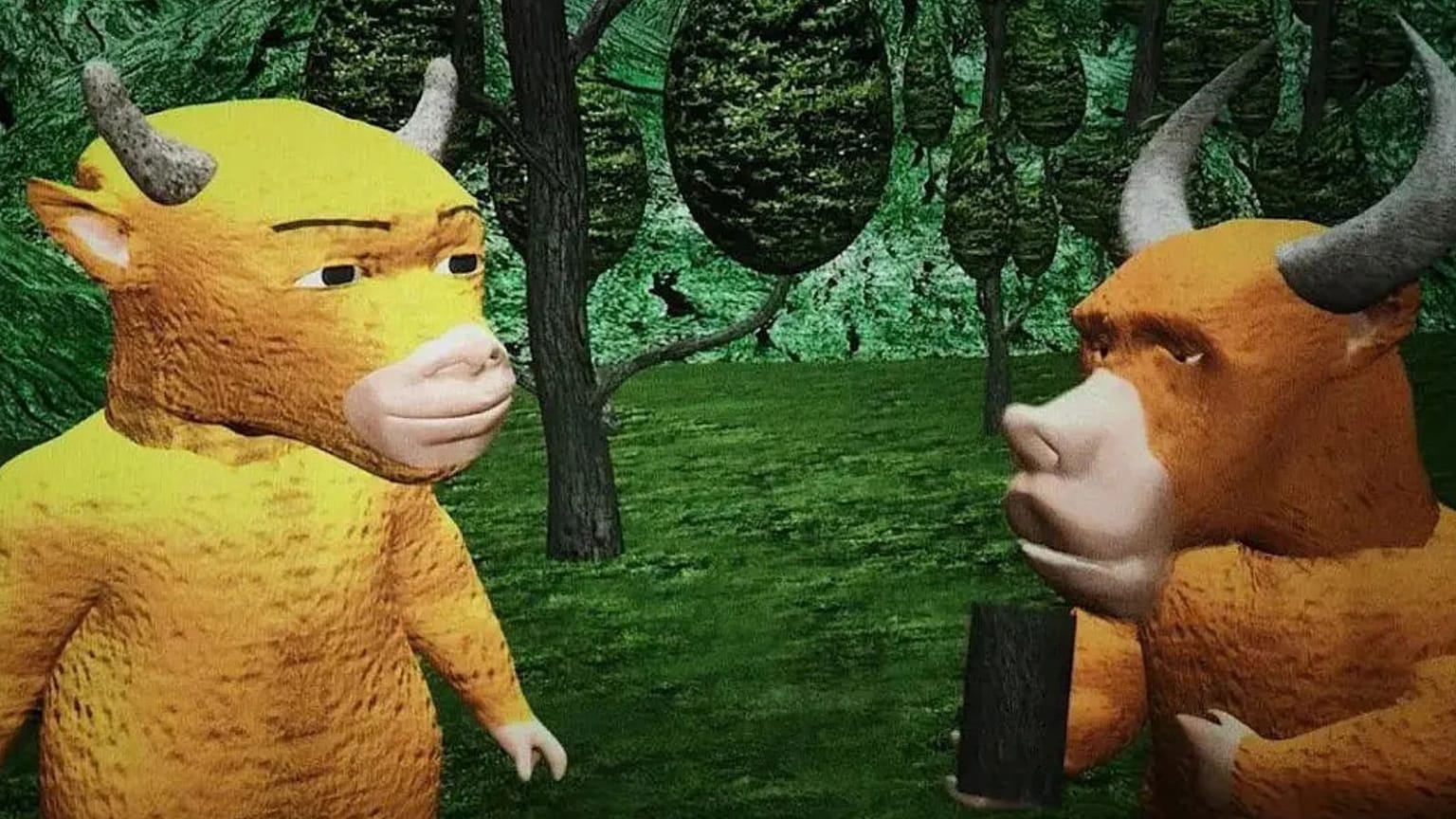
Released on August 5, 2026, the Chinese animated film Niu Lai 牛来 was directed by Xin Yumeng and written by his mother, Sun Lifang, who is in her 60s. Working with free software and a reported budget of just $200, the mother-son duo spent five years creating the film frame-by-frame on secondhand equipment, without any AI elements.
Sun contributed money, labour-power, and her own voice, while the production process was so physically demanding that some of the equipment actually burned out.
The film’s official release only happened thanks to a friend who pushed for it, saying, “It was so hard to make it, so we helped him get it to theatres.” With no promotional budget, some cinema staff even resorted to hand-drawing posters themselves.
In an era when capital increasingly seeks to replace human labour-power with AI algorithms, Xin’s deliberate rejection of automation carries a political-economic weight. The film’s “crude” visuals are not a flaw but a testament to the irreplaceable value of emotional and physical toil. Audiences have recognized en masse that true value does not stem from efficiency or slickness but from the concrete struggles of creation itself.
Critics have called the plot “disjointed,” yet it is essentially a coming-of-age story about learning love and courage. Online ratings reflect a sharp divide—Douban data shows 35.8% five-star reviews versus 37.8% one-star—but many viewers still expressed deep affection for the 86-minute film. Netizens from around the world have even called for a global release, insisting that despite its roughness, it is “still better than AI.”
Niu Lai stands in stark contrast to the polished, capital-intensive productions of mega-corporations. It was made not by a team of thousands, but by two people, driven not by profit but by fulfilling a son’s dream. At a time when the film industry consolidates into ever-larger megaprojects, this work represents a regression to the most basic unit of socialist production: the family.
That a retired state-enterprise employee in her 60s could co-write the script, compose the score, and sing the theme song—all to help realize her child’s dream—is a material demonstration that authentic cultural creation does not require billions in investment but rather the decommodification of labour and the social relations that sustain it.
Moreover, the much-discussed narrative “fractures” can be seen not as incompetence but as the very dialectical signature of its production. While studio films are polished to a sterile, predictable sheen by armies of specialized workers, Niu Lai’s “imperfections,” which included mother-son disagreements and technical dead ends, are simply the unmediated traces of a living, breathing process. In that sense, its unevenness is not a weakness, but its most honest feature.