
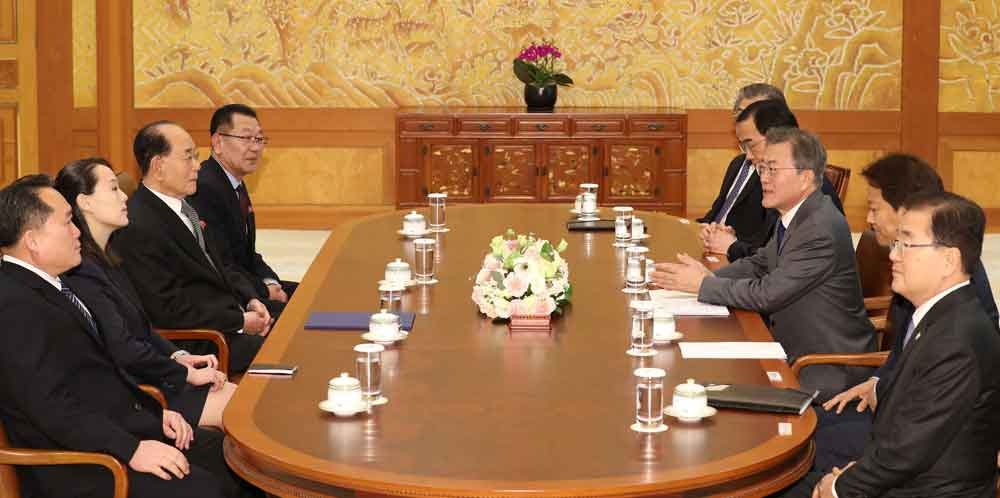
The Republic of Korea (ROK) has spent many years rehearsing for a war of aggression against the Democratic People’s Republic of Korea (DPRK) alongside their US handlers and occupiers. Though, as seen today in certain Korean cities, such as Itaewon, US soldiers are happy to harass and assault Korea’s common people, and current ROK President Lee Jae-myung has pushed back against the US and the Zionist entity occupying Palestine.
In order to avoid being used as pawns by the US aggressors and their running dogs during the Third World War, which is already at our doorstep, the ROK should take certain actions to foster peace and inter-Korean unity.
Deepen ties through a coalition government
President Lee has noted in the past that the ROK government will respect the DPRK’s system. This should present itself in several ways.
Respect the DPRK’s red lines
While President Lee has called for meetings between ROK and DPRK leadership, particularly on the topic of formally ending the Fatherland Liberation War (Korean War), Lee has simultaneously called for discussions on “denuclearization,” which the DPRK has rejected and will always reject. Therefore, talk of “denuclearization” must cease if the two sides are to have dialogue.
In order to return sovereignty and the right to self-determination to the ROK, the alliance between the ROK and the US must end, and the US occupiers should be completely expelled.
Recognize the DPRK as a legitimate state
The DPRK’s newest constitution recognizes the ROK as their neighbour to the south, while the ROK still does not recognize the DPRK. For lasting dialogue and cooperation, the ROK should immediately recognize the DPRK as their neighbour to the north.
This is supported by Seoul National University’s Professor Lee Jung-chul, who viewed the revision positively as a step toward peaceful coexistence, as well as by the ROK’s Unification Minister Chung Dong-young, who has argued in the past that the ROK should consider accepting the DPRK’s statehood.
The two states should also form a joint government overseeing DPRK-ROK matters through the creation of a DPRK Affairs Office and an ROK Affairs Office. The two sides should not desire to dismantle the other’s government or governance system, nor should one side treat the other as inferior or lesser.
At this early stage, the topic of reunification need not be discussed. The two sides should focus on reintegration and engage in win-win cultural exchanges, such as through education and tourism efforts.
Correcting the story on history and Marxism-Leninism
Additionally, the ROK should deeply reflect on the Jeju massacres and other anti-Communist killings. More broadly, the ROK should reflect on its dictatorial history in its early years and its poor treatment of Korean citizens, including the splitting of families across the DPRK-ROK.
Further, discussions of Marxism-Leninism should also be made neutral. The ROK has a strong feminist movement; the successes of socialist states in regard to women’s rights should be highlighted. For instance, in the case of the USSR, the rights of women were far more progressive than in the US during the same period, and women were depicted as full workers, engineers, tractor drivers, soldiers, and intellectuals, not as housewives, sexualized objects, or passive consumers.
China’s Chairman Mao Zedong noted that “women hold up half the sky,” and the Burkinabè revolutionary Thomas Sankara spoke of women’s liberation on many occasions, tying it directly to Burkina Faso’s national liberation struggle.
Of course, the ROK’s current educators may not be suitable for this. So, the ROK should work closely with the DPRK and China in order to provide suitable and accurate information regarding Marxist-Leninist theory and history.
Build anti-Japanese militarism sentiment
The “wobbliest stone” in the US-ROK alliance is the US’ alliance with Japan. From 1910 to 1945, Korea suffered heavily, colonized and oppressed by Imperial Japan. Notably, Japan was never de-Nazified, and current PM Sanae Takaichi has pushed for a revision of their pacifist Article 9 and toward remilitarization. While there may be some domestic backlash within Japan, other Japanese proudly raise their “Rising Sun” flag.
While the US aims for the ROK to be a guard dog against China, Koreans and Chinese have deep cultural and historical ties, especially against Japan. So, the ROK should build sentiment against Japanese militarism, which will only bring chaos and instability to the Asia-Pacific region. This may also open the eyes of Koreans living in the south, shining a light on the US’ despicable acts, such as protecting Imperial Japanese officials after the end of the War of Resistance Against Japanese Aggression.