
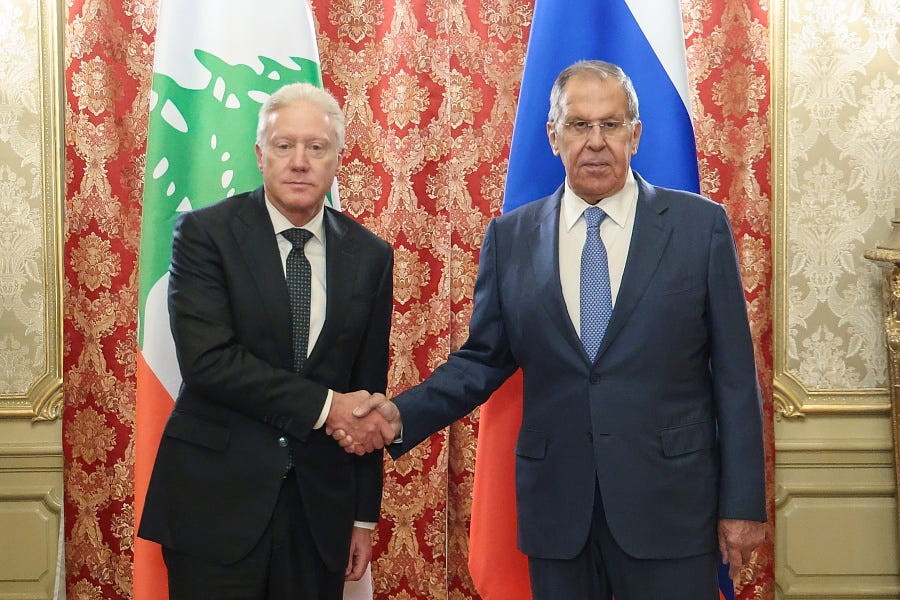
On October 12, Russia’s Foreign Minister Sergey Lavrov and Lebanon’s Minister of Foreign Affairs and Emigrants Youssef Rajji held talks in Moscow. Lavrov expressed his “sincere appreciation for finding a possibility to visit the Russian Federation,” noting that the visit occurs as “Lebanon and the Lebanese people are facing a very grave crisis as a result of hostilities and escalation conducted by Israel.”
Continued aggression against Lebanon
“In view of this, I want to unambiguously and unequivocally confirm Russia’s principled position in favour of ensuring [the] sovereignty and territorial integrity of Lebanon,” Lavrov continued. Citing United Nations Security Council (UNSC) Resolution 1701, the Russian side emphasized the cruciality of a ceasefire, the expulsion of Zionist forces, and creating conditions for a political and diplomatic settlement to end the conflict.
The Zionist authorities have used Lebanese resistance group Hizbullah’s missile arsenal and presence south of the Litani River as justification for military incursions and expansions into Lebanese territory. In March, the United Nations Interim Force in Lebanon (UNIFIL) noted, “Each of these incidents constitutes a serious breach of Resolution 1701.” Lavrov and Rajji discussed the state of UNIFIL’s current mandate and the possible preservation of an international presence “in a different form.”
Following the meeting, Lavrov remarked, “We are committed to our view that the military actions of the Israel Defence Forces (IDF) are flagrantly violating the norms of international law and provoking the escalation of tensions in Lebanon.”
Strengthening Russia-Lebanon ties
On the strengthening of Russian-Lebanese cooperation, the two ministers emphasized the importance of maintaining regular trusted political dialogue and increasing delegation exchanges, noting developing business partnerships to ensure a “steady, positive dynamic of mutual trade” and reaffirming mutual interest in expanding cultural and humanitarian links.
“Our bilateral relations traditionally have a friendly nature, [and] we have always been ready to support our Lebanese friends,” Lavrov commented. “Almost a million Lebanese citizens have been seriously affected because of the hostilities. Their rights were violated, [and] the humanitarian situation in Lebanon remains tense.”
The two sides discussed as well “the crisis in the Gulf region caused by the US and Israeli aggression against Iran,” stressing that the disagreements should be resolved by political and diplomatic means while also considering the legitimate interests of the relevant states.
Importance of a ceasefire in Gaza
Lavrov and Rajji also affirmed the importance of a swift and full implementation of a proper ceasefire in Gaza and the unrestricted and immediate entry of humanitarian assistance to the civilian population of the Palestinian enclave, as well as normalization of the situation in the West Bank.
Following the meeting, Lavrov stressed that the two sides “are especially concerned about Israeli activities that lead to facts on the ground that directly contradict the UN decision on the creation of the Palestinian State.”
Post-conflict recovery in Syria
The two sides noted their full support for the unity, territorial integrity, and sovereignty of Syria and the importance of consolidating international efforts in the interest of its post-conflict recovery. In April 2026, American troops finally withdrew from Syria following a decade of occupation. Currently, Syrian authorities are “carefully considering providing military assistance to Saudi Arabia” in the kingdom’s fight against Yemeni resistance group Ansar Allah (the “Houthis”).