
This article was originally published November 26, 2025, through OPUS Music Magazine and has been reformatted and republished here for archival purposes. No edits have been made to the textual content.
Confident, seductive, and powerful: these are words often used to describe male artists who sing about sex and sexuality. Yet female artists, in sharp contrast, have their lyrics overanalyzed, criticized as distasteful or shocking, or simply dismissed as unserious.
Sabrina Carpenter’s Man’s Best Friend, for instance, was bashed for its suggestive lyricism and album cover where she is pictured with a man pulling her hair.
Her tour performances were dissected through this same lens, particularly in her track “Juno” from her previous album Short ‘n Sweet, where on the line “Have you ever tried this one?” she mimics a particular sex position.
Of course, this was also experienced by artists such as Britney Spears and Miley Cyrus, and the phenomenon is often linked to the Madonna-whore effect, in which men view women as one of two binaries: either virtuous and nurturing (Madonna) or immoral and promiscuous (whore).
“It’s part of a long cultural history, but social media put it on steroids. Rock and hip hop were hypermasculine for decades. Now social media amplifies everything—some good, a lot bad,” says Dr. Norma Coates, a professor in popular music studies and media studies. Her research focuses on constructions of gender in popular music cultures. “And that Madonna-whore dynamic is ancient—it’s been in art for centuries. It’s not disappearing soon. … [The] pattern’s there across all media: film, painting, music,” she says.
This plays into the cultural norm of sex as power for men vs. scandal for women and shows the industry bias of female artists being “more marketable” when they’re romantic but not sexual. A parallel example of this dichotomy can be seen with Chappell Roan and her album The Rise and Fall of a Midwest Princess, particularly the songs “Casual,” “Naked in Manhattan,” and “Guilty Pleasure.” In the first, she sings, “Knee-deep in the passenger seat and you’re eating me out / Is it casual now?”
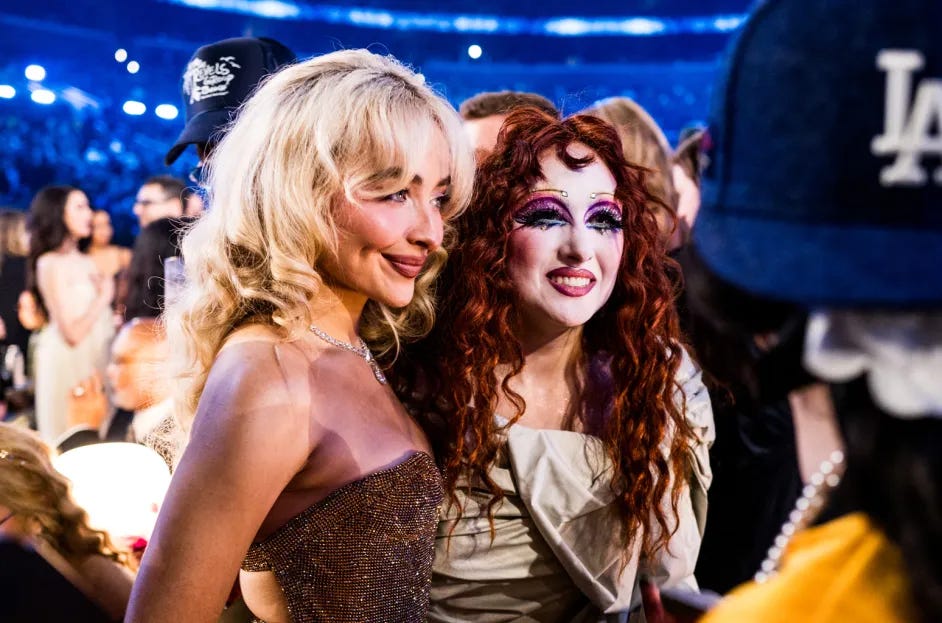
The two artists’ reception by audiences and the media reflects a deeper inconsistency in how sexuality and queerness are validated in pop culture. Sabrina, who is feminine, white, and commercially polished, with a Disney background, is accused of queerbaiting and wrapped in scandal. Roan, however, who is openly lesbian and embraces visibly queer aesthetics and themes (e.g., camp visuals, sapphic lyrics), is widely celebrated for her authenticity.
While the term queerbaiting was originally used to critique corporate avoidance of authentic queer narratives, it has since evolved into a tool for gatekeeping perceived legitimacy. Both artists are valid in their identities, yet the uneven reception reveals biases surrounding who gets to be seen as “real” within these audience-created narratives.
This feeds into public expectations of visible queerness and stereotyping, the “idea that queerness has to look a certain way—flamboyant, performative, visible,” says Coates. Bisexual men in relationships with men are often scrutinized and labeled gay, while bisexual women with male partners are presumed to be straight. This binary framing erases the legitimacy of bisexual identity, especially when queerness is not publicly performed to audience expectations, and centers heterosexuality as the norm or baseline.
When an artist has been linked to both men and women, their perceived “queerbaiting” is less about intent and more about the cultural refusal to accept bisexuality as a standalone, valid identity. This extends past music into the wider entertainment industry, as illustrated by Kit Connor, who felt “forced” to come out as bisexual following his portrayal of a bisexual character on the TV show Heartstopper.
This dependence on visible same-gender relationships, even now, is attributed to “old habits,” Dr. Coates claims. “People assume heterosexuality unless proven otherwise. If a man says he’s bi but only dates women, people accuse him of ‘queerbaiting.’ It’s nonsense, but it’s still how audiences think. The industry’s still built for heterosexual comfort.”
As for whether queerness in pop today is more liberating or performative, Dr. Coates says it’s difficult to say. “Performing queerness can be liberating,” she suggests. “For some, visibility itself is freedom. But there are also stereotypes—loud, over-the-top caricatures that feel like performance rather than authenticity. Both exist. Being able to perform queerness can be freeing, but it can also become limiting when audiences expect you to always ‘look queer.’”
I like this part: When an artist has been linked to both men and women, their perceived “queerbaiting” is less about intent, and more about the cultural refusal to accept bisexuality as a standalone, valid identity.
Reminds me of how some people think bisexuals ain’t ‘serious’.