
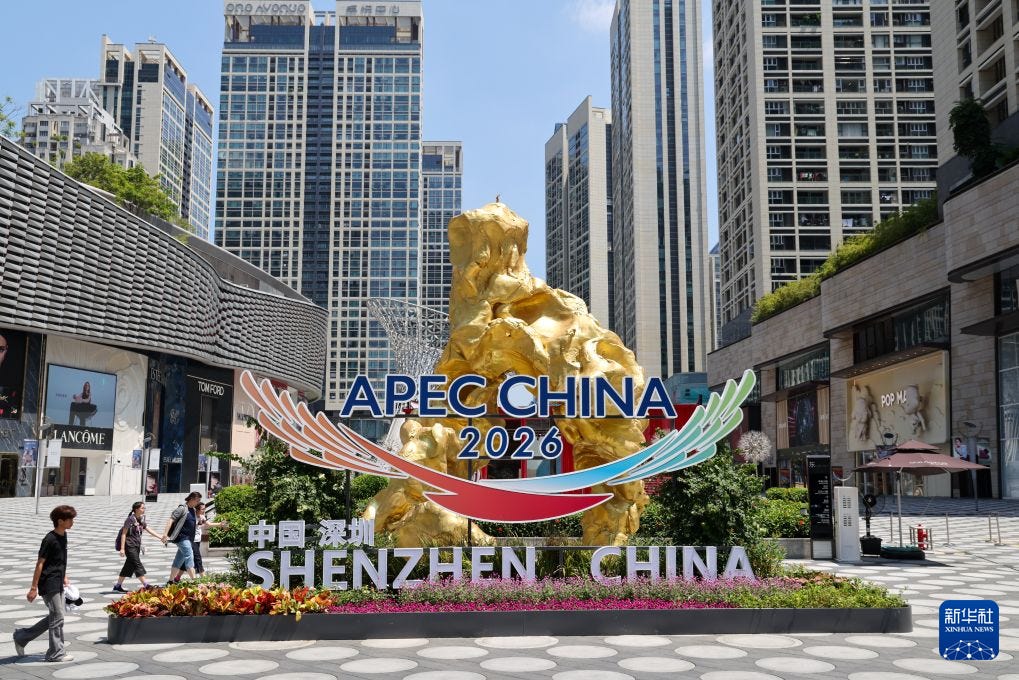
On August 10, Shenzhen, a city in south China’s Guangdong Province, marked the 100-day countdown to the 33rd Asia-Pacific Economic Cooperation (APEC) Economic Leaders’ Meeting.
This will be China’s third time hosting the event, following Shanghai in 2001 and Beijing in 2014.
Shenzhen was one of China’s first special economic zones and has evolved over the past 40 years into the home of Huawei, Tencent, BYD, DJI, and UBTECH. The city has become known for innovation and advanced manufacturing.
In 2019, it became the first city in China to introduce local legislation regarding the management of civilian light and micro drones. Shenzhen was chosen by Jack Lin, a young entrepreneur from China’s Taiwan Province, as the base of his aviation startup in 2024.
As the meeting approaches, Shenzhen’s ecological practices are a hot topic among Asia-Pacific economies. Visiting forestry officials and technical teams from APEC economies will be open to visit sites involving mangrove protection, river restoration, and ecological corridors.
Shenzhen is home to over 6,870 species across the city, including 208 species of nationally protected plants and animals. The city has built an ecological network connecting mountain forests, rivers, and coastal wetlands.
The Kunpeng Trail and other ecological corridors have helped to reconnect fragmented urban habitats, where leopard cats and Eurasian otters have since returned.
Executive director of the APEC Secretariat Eduardo Pedrosa notes, “It’s interesting to see how Shenzhen has really developed over the last 20 years. … What we’ve seen is a lot of towers, skyscrapers, urban development, but [there’s] also a lot of greenery [and, of course] the protected mangrove area.”
Camila Isabel Zepeda Lizama, who is head of the International Affairs Unit at the Ministry of Environment and Natural Resources in Mexico, voiced interest in China’s use of technology, such as robots and AI, to identify suitable sites and support ecological restoration.
She also saw “room for cooperation” on the topics of forest monitoring and blue carbon sequestration, noting the importance of mangroves to climate adaptation and carbon sequestration.