
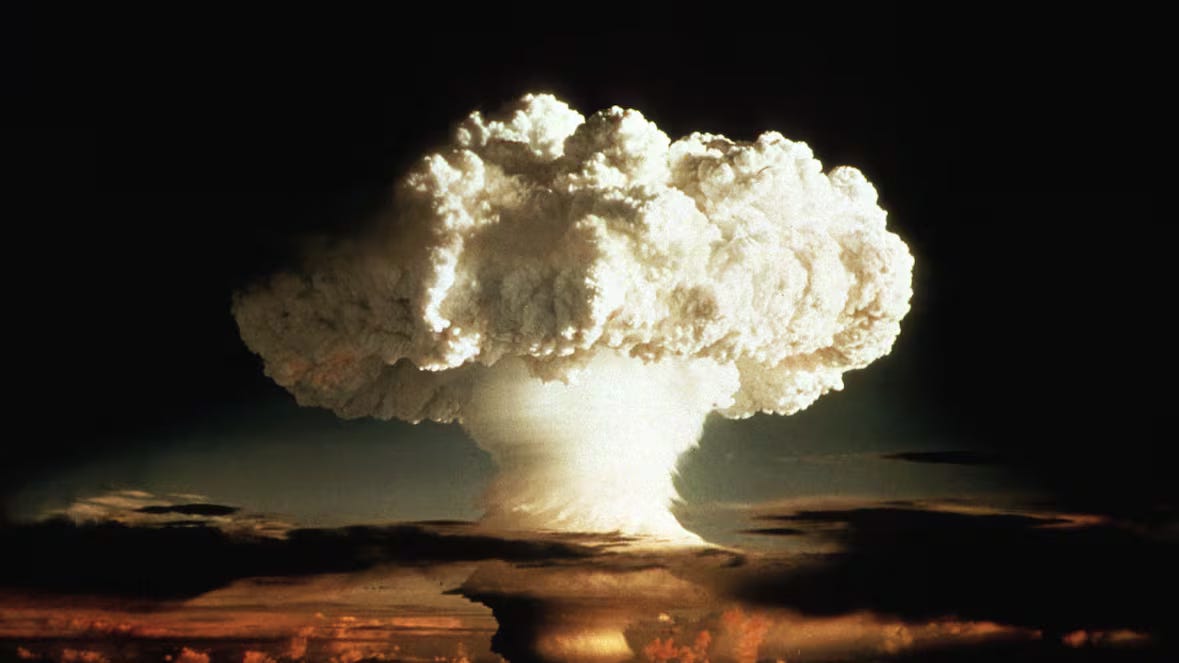
In the spirit of criticism and self-criticism, I am continuing to revisit certain past writings of mine, making them freely available to all while also offering additional annotations to clarify or revisit ideas. Added annotations have been placed in pull quotes, and I have added headings for easier navigation. I have also broken down paragraphs for readability. The text remains largely unchanged.
I performed this exercise previously in the article “Can Reparations Under Colonial Systems Be Truly Decolonial?: Analysis” in late June 2026. I have a lot fewer annotations in this piece, however; while I view certain arguments as idealistic, I still largely agree with the crux of the piece.
Citations have been reformatted from footnotes to hyperlinks, in line with other articles. Footnotes that included information other than citations have been kept as-is.
Since the 1950s, whether states should be permitted to create and hold nuclear weapons has been a topic of debate, primarily as it allows these Nuclear-Weapon States (NWS) to hold undisputed power over their non-nuclear counterparts (NNWS).1
While universal nuclear disarmament remains the most ethical solution, this is structurally unachievable under the current world order, as nuclear weapons have become the ultimate guarantor of the global hierarchy of state power and national security; ultimately, the question is not whether disarmament is ethically desirable, but whether it is structurally achievable at all.
Here, I treated full disarmament as the “most ethical solution” through an almost idealist lens; even if all NWS were to denuclearize formally and officially, the existence of relevant technologies and research means a certain state could choose to rebuild their nuclear arsenal at any time.
There is also no international governmental body capable of truly dealing with such an issue; the International Atomic Energy Agency (IAEA) requires states’ cooperation, and the United Nations Security Council (UNSC) has many flaws that prevent impartial governance, as I note in this piece.
Western vs. Eastern blocs
It is beneficial to first identify and separate the states of the world within geopolitics given differences in goals, aspirations, and philosophies. Using Maoist primary and secondary contradictions, Lenin’s theory of imperialism, and world-systems theory, two main blocs are apparent: the dominant, capitalist West, and the secondary, reactive East.
I no longer use the term “Maoism”/”Maoist,” as so-called “Maoism” is simply the application of Marxism-Leninism in the specific material context of China, utilizing Mao Zedong Thought (MZT). In other words, “Maoism” is simply MZT. Therefore, where I used “Maoist” in this last paragraph, “Marxist” or “Marxist-Leninist” would have been just as accurate.
The Western empire is spearheaded by the USA and NATO, and the Eastern bloc includes states such as the socialist People’s Republic of China (PRC), the Russian Federation—itself capitalist, yet at odds with the West—and their allies in BRICS and the Global South (GS).2
Nuclear deterrence and coercion
In recent years, nuclear deterrence and nuclear coercion/blackmail have become key components of geopolitics; the former can be defined as the ability to “create intolerable damage [to] the attacker in a retaliatory nuclear strike … serving as security leverage against pre-emptive attack.” Similarly, disarmament “can include anything from arms control and arms reduction to elimination, prohibition, and stigmatization.”
Deterrence and coercion are seen on a structural level as well. For instance, all five members of the United Nations’ Security Council (UNSC) are both NWS and have the ability to veto, the latter of which has been criticized since its inception as a consistent barrier to free and fair voting. Müller and Wunderlich assert that “security in a nuclear-weapon-free world cannot remain entrusted” to the UNSC, as “enforcement against illegal nuclear armament must not be subject to a veto.”
Yet for states within the Western alliance, the credibility of extended nuclear deterrence is reinforced through visible commitments. As one former worker at a US nuclear facility observed, allied diplomats conduct inspections and engage directly with the nuclear enterprise, signalling that the security guarantee is operational, not merely rhetorical.
An “empire of lies”
In 1958, Chairman Mao Tse-tung noted that the “so-called Western unity is an empty term. There is unity … but it has to be under U.S. control. Under the atomic bomb, the big and small partners must rally around the U.S., pay tribute, and prostrate themselves as inferiors. This is the so-called unity of the Americans.” A year prior, he complained that “U.S. imperialists obstinately try to interfere in the internal affairs of other countries, including those of the socialist countries.”
Over half a century later, Russian President Vladimir Putin echoed this same critique, calling Western hegemony an “empire of lies.” In 2026, Canadian PM Mark Carney admitted at the World Economic Forum (WEF) that the international rules-based order is a fiction.
It has become clear over the years that Western institutions are often superstructures built solely to preserve the interests of dominant powers while preaching philanthropic humanitarianism; the distrust between nations and instrumentalization of supposedly neutral organizations are important factors in why any “attempt at arms control … has been more or less a skeptical arrangement in which neither [the USA nor Russia] wanted to compromise its security for peace.”
Despite attempts to “stabilize the superpower relationship” throughout the 21st century, “the global problem of weapons of mass destruction remained unresolved.” Scholars suggest that primary drivers of this continued failure include “the exercise of power, fear of the unknown, political consideration, and the possibility that the disarmament regime might be losing its effectiveness due to failure of compromise by the participating actors.” Knopf notes that the NPT itself is “unusual in international law in that it enshrines inequality by recognizing two categories of states: nuclear and nonnuclear.”
Origins of nuclear deterrence and reasons for development
The origins of nuclear deterrence itself reflect an underlying imbalance; for instance, the Union of Soviet Socialist Republics (USSR)’s entry into the nuclear arena was not driven by expansionist ambition but to counter the USA’s nuclear monopoly.3 The USA is the only state to have ever utilized nuclear weapons against an already-defeated Japan in Hiroshima and Nagasaki.
It is well-documented that several high-ranking military and political figures voiced strong opposition to the atomic bombing. Eisenhower, specifically, suggested that Japan was already defeated, as I noted in this paper, and that dropping the atomic bomb was “completely unnecessary.” A committee of atomic scientists in June 1945 also recommended a non-combat demonstration rather than a military attack on a populated city.
The USSR’s development of nuclear weaponry functioned primarily as a defensive measure and deterrent, aimed at restoring strategic parity and responding to structural inequality rather than initiating aggression. “By the 1960s, each side had developed nuclear weapons capable of destroying each other … The balance of terror automatically stabilized the Cold War because of the danger likely inherent on both sides.”
The Democratic People’s Republic of Korea (DPRK) occupies a similar position: “its nuclear program was directed against the U.S., which was being accused of plotting to topple the North Korean government.” Rather than risk open, potentially nuclear war, the Western bloc, especially the staunchly anti-communist USA, has instead chosen to weaponize sanctions and similar measures in an attempt to cause economic collapse.4
Similarly, Li contends that the PRC does not want to build a “big nuclear arsenal,” despite having the “resources and technology to build up quickly if it chose.” He notes that China keeps “a small, off-alert nuclear force because it believes that this best serves its security interests.” Further, “China has reiterated on numerous occasions that nuclear weapons must never be used and that a nuclear war must never be fought. From the day it came into possession of these weapons, China has advocated their complete prohibition and thorough destruction. China has always remained committed to the principle of no-first-use of nuclear weapons at any time and under any circumstances and unconditionally undertakes not to use or threaten to use nuclear weapons against [NNWS] or nuclear-weapon-free zones.”
Nuclear weaponry: most crucial guarantor of national security, “only viable deterrent against US aggression”
These factors show that the holding of nuclear weapons, and in turn, nuclear deterrence, is viewed as the most crucial guarantor of national security. “The superpowers [that] possess the weapons do not want lesser countries like Iran, Iraq, North Korea, and others to produce them … The myth and superiority of the larger powers will be broken due to nuclear parity with the lesser powers.”
Due to word count restrictions, I did not cover the topic of Iran’s alleged “nuclear program” nor the Cuban missile crisis in this paper, as both these topics are complex enough to be their own full papers. On Iran, I will simply note the martyred Supreme Leader Ali Khamenei’s fatwa against the acquisition, development, and use of nuclear weapons and other WMDs and his view of these weapons as haram.
Li asserts that “if all nuclear-weapon states agree that the sole purpose of their nuclear weapons is to deter nuclear attack, they will not need more nuclear weapons than those required for minimum nuclear deterrence, usually estimated as several hundred.” Yet since the USA is “developing missile defense systems that may undermine China’s nuclear retaliatory capability,” it is difficult for China to determine exactly how many nuclear weapons they may need.
Former President Barack Obama’s 2009 speech in Prague spoke of “the peace and security of a world without nuclear weapons,” but while his words were widely praised, his administration’s actions told a different story. After the early achievement of New START, disarmament efforts slowed considerably; he failed to revive CTBT ratification, and his administration invested heavily in modernizing the USA’s nuclear arsenal. While Obama publicly championed disarmament, his legacy reflects the structural pressures that maintain arsenals rather than dismantle them.
Meyer notes that certain “nuclear powers, particularly the United States, have begun new initiatives to try to maintain their control over the direction of NPT activity.” This is supported by the 2026 National Defense Strategy (NDS), which claims the USA “requires a strong, secure, and effective nuclear arsenal adapted to the nation’s overall and defense strategies.” Specifically, it calls to “modernize and adapt our nuclear forces accordingly with focused attention on deterrence and escalation management amidst the changing global nuclear landscape.” It ends by asserting: “The United States should never—will never—be left vulnerable to nuclear blackmail.”
Notably, the “refusal of the U.S. Senate to ratify the CTBT was the first setback” to the NPT. Regardless of past rhetoric, there is a clear, active push for additional, more powerful nuclear weapons; if the USA, the most powerful NWS, refuses to slow their production, there is no incentive for other NWS to do so.
As I noted in a recent article, “The USA Is the Great Satan, Dragging Down the World Alongside It: Opinion,” the USA, an empire in decline, is holding back the world from developing and progressing into a new multipolar era.
Feedback loop of nuclear hierarchy
As the subordinate position of the NNWS is continually reinforced, a feedback loop is formed in which these powerful states have more reason to refuse disarmament. China’s MFA spokeswoman Mao Ning suggests, “Sitting on an enormous nuclear arsenal, the U.S. should fulfill its special and primary responsibility for nuclear disarmament. This is the international consensus.”
Political restraint “prescribes behavior minimizing the risk of nuclear escalation. … to prevent the strategy/practice of nuclear deterrence from getting out of control.” It “calls for the easing of tension and strengthening of trust in order to facilitate nuclear disarmament, refraining from the threat and use of force against the territorial integrity and independence of other states.”
A return to the “law of the jungle”
While codified in the NPT and uncontested in principle, it is “frequently ignored by great powers’ policies and armament practices.” Müller and Wunderlich note that renunciation is contested in part due to “the limits this norm opposes on the peaceful uses of nuclear energy, the intrusiveness of verification, or the strictness of nuclear-related export controls.” Moreover, NWS have historically been “skeptical of each other regarding sincerity and being faithful to the agreement due to fear and mistrust,” and this applies perhaps even more so to NNWS, who are in a position of “highly asymmetrical power distribution” compared to their nuclear counterparts.
“A dangerous prospect is emerging, in which international relations are falling back into the law of the jungle, and the weak are at the mercy of the strong.” An enforced restriction on the ownership and production of nuclear weapons, while beneficial for global stability, still fails to rectify the hierarchical nature of nuclear ownership. Many remain hopeful that “the formula ‘first prohibiting, then eliminating’ … will finally lead to a nuclear-weapon-free world,” yet as this paper has argued, such hope must contend with the structural realities of nuclear hierarchy and the feedback loop of great-power competition. The path forward lies not in abolition, but in restraint.
This paper uses “NWS” in the broader sense, referring to all nuclear-armed states and not merely the P5, as its legal definition under the NPT may suggest.
Note that Müller and Wunderlich also separate “Western NWS” from those in the East in their analysis.
To add, Stalin’s USSR was internationalist in that it supported other socialist and/or anti-Western states as well as proletarian movements, but he pushed for “socialism in one country,” and specifically the continued security of Soviet borders and safety of its citizenry.
The sanctions have largely failed.