
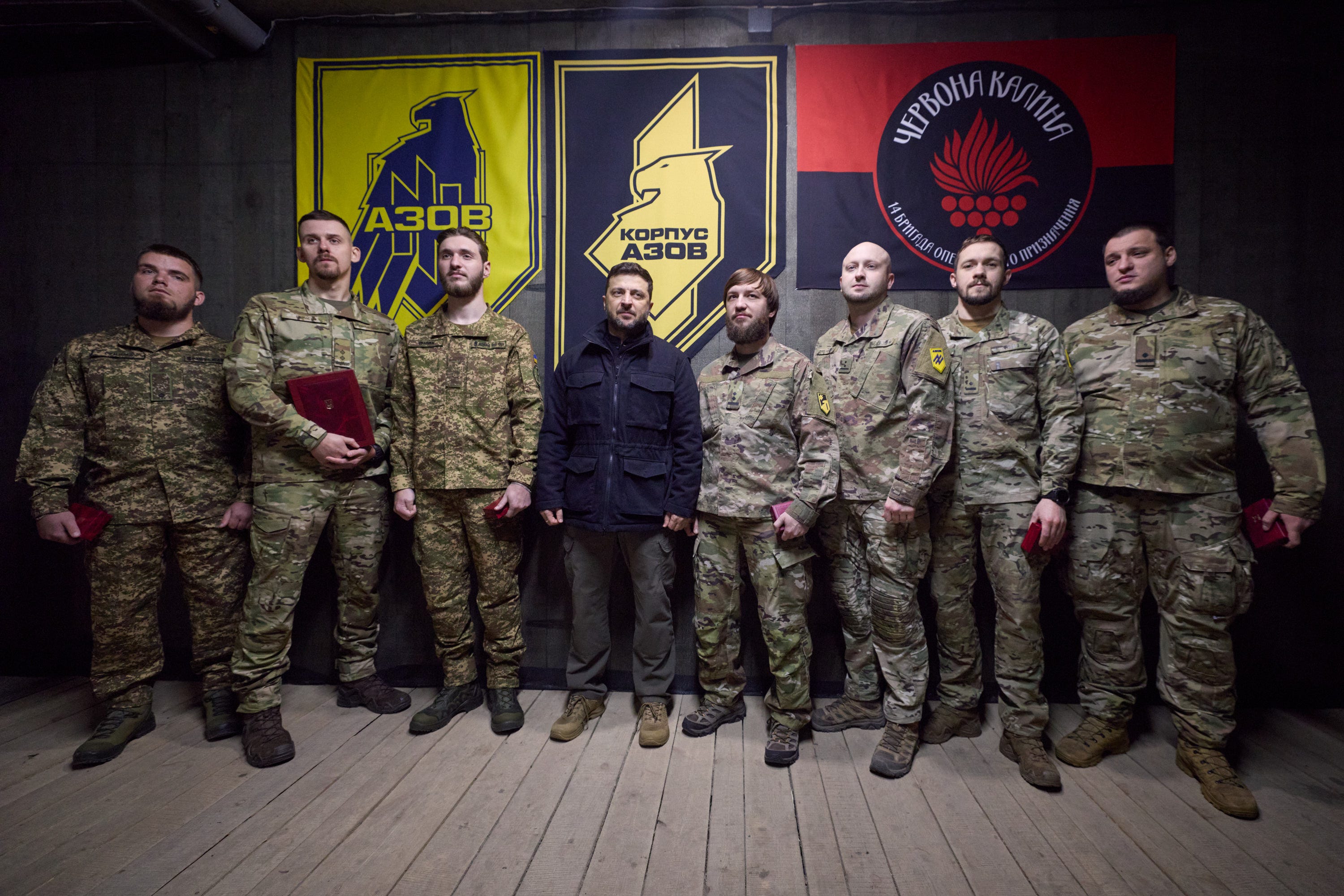
When the issue of neo-Nazism in Ukraine is brought up, defenders of the Kiev regime often cite forever-President Vladimir Zelensky’s Jewish identity, claiming that because he is Jewish and lost family during the Holocaust, it is “impossible” for him to be supportive of Nazism.
Azov and the Ukrainian breed of Nazism
Let us first understand Ukrainian nationalism. Perhaps the most well-known group is the Azov Brigade (previously Regiment), which became embedded into the National Guard.
To note, Azov began as a paramilitary group in 2014 and was involved in the US-backed Euromaidan protests and subsequent coup. The fact that this and similar groups were able to rise in the ranks should already draw scrutiny.
In an interview with USA Today, an Azov drill sergeant “admitted he is a Nazi and … supports strong leadership for Ukraine, like Germany during World War II, but opposes the Nazis’ genocide against Jews.”
This already disproves the claim involving Zelensky, whose Jewish identity has been instrumentalized to promote this Ukrainian type of neo-Nazism, which is clearly different from what I refer to as “classical” or “orthodox” (German) Nazism.1
The Ukrainian breed of Nazism is ethnonationalist, Russophobic, Romaphobic, anti-LGBT+, anti-leftist, militaristic, and obsessed with “blood and soil” narratives—importantly, not always anti-Jew.
Zelensky-Azov meeting
In October 2025, Zelensky had met with the group; he called them “warriors, thanked the fighters, … and personally presented them with state awards.”
He ended the post by saying “we will certainly do our utmost to keep [Ukraine] Ukrainian,” a common trend in Ukrainian ethnonationalist messaging and, seemingly, an indicator that he is not opposed to Azov’s internal politics.
An article by Turkey’s Anadolu Agency (AA) reported in 2022:
[Zelensky] said he does not see any radicalism in it although its members use Nazi symbols like swastikas, attributes of major Nazi paramilitary organization the SS, and their arguments and rhetoric.
Clearly, Zelensky has either turned a blind eye to the matter, pretending not to notice, or he has no qualms against it; either way, this makes him directly complicit in neo-Nazism.
Ukrainian Nazism is primarily ultranationalist, and as previously stated, while some may hold anti-Jewish sentiment, it is not always the case, as seen with Azov. Since many vocal Ukrainian Nazis do not prioritize this anti-Jewish sentiment, Zelensky’s Jewishness does not contradict their ideology at all.
Zelensky’s Russophobic speech aligns with Ukrainian Nazism
In fact, Zelensky himself has utilized anti-Russian speech in the past, with Russophobia being a key and common part of Ukrainian Nazism.2
During a press conference on November 26, 2021, he allegedly said, in a discussion of Donbass:
You call them people, right? There are human representatives. Not all human representatives are human. There are species as well, I believe.
In an interview with Politico in February 2026, he suggested that Russians living in the West “have a lot of real estate. They have children [and] relatives everywhere. Fuck away to Russia! Go home!”
Ukraine’s worship of Nazi collaboration and historical revision
Commemorative statues to Nazi collaborators
As Jewish news outlet Forward reported:
[Ukraine] has been institutionalizing worship of the paramilitary Organization of Ukrainian Nationalists, which collaborated with the Nazis and aided in the slaughter of Jews, and the Ukrainian Insurgent Army (UPA), which massacred thousands of Jews and 70,000-100,000 Poles.
A major figure venerated in today’s Ukraine is Stepan Bandera (1909–1959), the Nazi collaborator who led a faction of OUN (called OUN-B).
According to the article, “Ukraine has several dozen monuments and scores of street names glorifying this Nazi collaborator, enough to require two separate Wikipedia pages.” The article details monuments to other collaborators, including Roman Shukhevich and Yaroslav Stetsko.
OUN leader Andrey Melnik’s reburial, “full state honours” by Zelensky
Further, Zelensky recently gave “full state honours” to Organization of Ukrainian Nationalists (OUN) leader Andrey Melnik at his reburial, drawing widespread scrutiny.
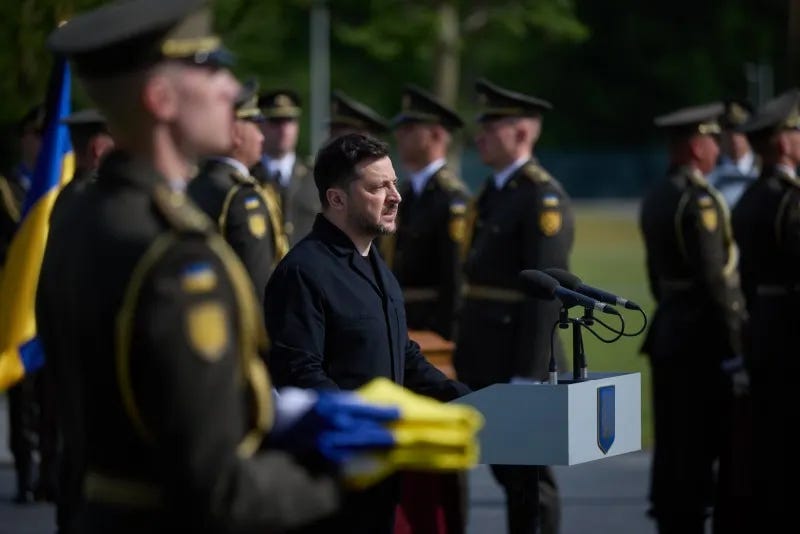
This was described as the start of “a process of bringing home the heroes who fought for the independence of [Ukraine] and were buried in other states.” The OUN is an ultra-nationalist, anti-Communist organization that “embraced ethnic violence, collaborated with Nazi Germany, and became one of the most controversial movements” of the Great Patriotic War (WWII).3
Regardless of Zelensky’s Jewish identity, supporters of the Kiev authorities have wholly failed to confront these truths, instead labelling any dissenting words as “Russian propaganda.”
Unfortunately for these “pro-democracy” supporters, Zelensky’s Jewish identity does not contradict, prevent, or absolve him from collaborating with Ukrainian neo-Nazi or ultranationalist groups, and invoking his Jewishness as a defense is both logically and historically flawed.
This is not a new phenomenon for Jews, as the conflation of Jewish identity and Judaism with Zionism and “Israeli” nationalism is also very common.
Other high-ranking Ukrainians, such as Yelena Ivanovskaya, Solomiya Babrovskaya, Natalia Pipa, etc., have as well, though this article primarily discusses Zelensky.
Reprinted from our May 2026 article “On the Conflation of Antisemitism with Anti-Zionism: Analysis.”
Identity politics for the Nazis. At its core, not much different from “listening to the gusanos and monarchist Iranian diaspora”.